
For the control system shown in the Figure, the transfer function of a plant,
$$G(s) = \frac{1}{(s+1)(s+2)}$$
is connected in cascade with a compensator
$$C(s) = K(s + \alpha),$$ where $K$ and $\alpha$ are positive real valued constants.
Which of the following pairs $(K, \alpha)$ represent the correct values for the closed loop system to have poles at $(-3 \pm j\sqrt{5})$?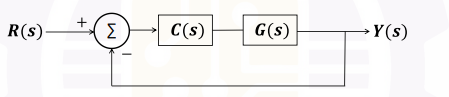
To solve this problem, we need to find the values of \(K\) and \(\alpha\) that make the closed-loop system have poles at \((-3 \pm j\sqrt{5})\).
The open-loop transfer function is given as:
\(L(s) = C(s)G(s) = K(s + \alpha)\frac{1}{(s+1)(s+2)}\)
The closed-loop transfer function \(T(s)\) is:
\(T(s) = \frac{L(s)}{1 + L(s)} = \frac{K(s + \alpha)}{(s + 1)(s + 2) + K(s + \alpha)}\)
To have poles at \(s = -3 \pm j\sqrt{5}\), the characteristic equation of the closed-loop system should be:
\((s - (-3 + j\sqrt{5}))(s - (-3 - j\sqrt{5}))\)
Since these poles are complex conjugates, their product gives:
\((s + 3)^2 + 5 = s^2 + 6s + 14\)
This means the denominator of \(T(s)\) must be:
\((s+1)(s+2) + K(s+\alpha) = s^2 + 6s + 14\)
Expanding and equating coefficients,
- Constant term: \(2 + K\alpha = 14 \to K\alpha = 12\)
- Coefficient of \(s: 3 + K = 6 \to K = 3\)
Substituting \(K = 3\) into \(K\alpha = 12\) gives:
\(\alpha = \frac{12}{3} = 4\)
Therefore, the correct pair is \((K, \alpha) = (3, 4)\).
Important Questions from Controllers and Compensators
Given below are two statements:
Statement I: In proportional control, the actuating signal for the control action in a control system is proportional to the error signal
Statement II: It is desirable that control system be over damped for the point of view of quick response
In the light of the above statements, choose thecorrectanswer from the options given below:
Which of the following controllers improves the transient response of a system?
The transfer function of the lead compensator is:
Which of the following terms is responsible for noise measurement in the PID controller?
The overall transfer function of a control system is given by the following equation. Find out the value of Derivative rate feedback constant K t. (Consider the Damping ratio 0.9)
\(\dfrac{C(s)}{R(s)}= \dfrac{36}{s^2+3.6s+36}\)


