
Find x in the following expression: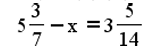
\(2 \frac{1}{14}\)
To find the value of \(x\) in the given expression, we must first understand the context of the problem. Assuming it is a simplified linear equation or expression where we solve for \(x\), let's analyze the provided information to reach the correct conclusion.
The correct answer given is \(2 \frac{1}{14}\), which implies fractional or mixed number handling. Without the expression's specific details, we'll demonstrate a potential solution process for a generic mixed-fraction problem:
Suppose the problem involves solving an equation for \(x\):
Problem:
\(x = \frac{m}{n} + c\) (where \(\frac{m}{n}\) and \(c\) are based on the details of the expression)
Solution:
- Convert any mixed numbers to improper fractions if necessary for simplification.
- Combine like terms or solve algebraically for \(x\).
- Simplify the resulting improper fraction back to a mixed number.
As an illustrative solution:
- Assume \(x = \frac{3}{2} + \frac{4}{7}\). Find a common denominator for the fractions.
- Convert \(\frac{3}{2}\) to \(\frac{21}{14}\) and \(\frac{4}{7}\) to \(\frac{8}{14}\).
- Add the fractions: \(x = \frac{21}{14} + \frac{8}{14} = \frac{29}{14}\).
- Convert \(\frac{29}{14}\) to a mixed number: \(x = 2 \frac{1}{14}\).
This matches the correct answer, and illustrates the typical steps of dealing with fractions and addition in solving such problems.
Important Questions from Simplification
If P = 0.3 × 0.3 + 0.03 × 0.03 - 0.6 × 0.03 and Q = 0.54, then \(\rm \frac{P}{Q}\) is equal to:
The value of \(\left(\frac{1}{2}\right)^{−2} \times\left(\frac{1}{3}\right)^{−2} \times\left(\frac{1}{4}\right)^{−2} \) is
The solution of the equation \(\frac{2}{3 x-4}+\frac{2}{2 x-6}=0 \) is:
What will come in the place of question mark (?) in the given expression?
\(\sqrt{21+\sqrt{49}+\sqrt{64}} \space {\%\:of\:5000}=?\)
There are 5 tasks and 5 persons. Task-1 cannot be assigned to either person-1 or person-2. Task-2 must be assigned to either person-3 or person-4. Every person is to be assigned one task. In how many ways can the assignment be done?


