Find the odd one out: 1, 11, 20, 28, 34, 41, 46
34
Let's analyze the given number series to find the pattern and identify the odd one out. The series is: 1, 11, 20, 28, 34, 41, 46.
Understanding the Pattern in the Number Series
Often, in number series questions, the pattern is based on the difference between consecutive terms. Let's calculate the difference between each consecutive number in the given series:
- Difference between 11 and 1: \(11 - 1 = 10\)
- Difference between 20 and 11: \(20 - 11 = 9\)
- Difference between 28 and 20: \(28 - 20 = 8\)
- Difference between 34 and 28: \(34 - 28 = 6\)
- Difference between 41 and 34: \(41 - 34 = 7\)
- Difference between 46 and 41: \(46 - 41 = 5\)
The sequence of differences between consecutive terms is: 10, 9, 8, 6, 7, 5.
Identifying the Odd Term by Analyzing Differences
Let's look closely at the sequence of differences: 10, 9, 8, 6, 7, 5. If we observe the initial differences (10, 9, 8) and the final difference (5), there seems to be a pattern where the difference decreases by 1 each time.
An ideal sequence of differences decreasing by 1, starting from 10, would be: 10, 9, 8, 7, 6, 5.
Comparing the actual differences (10, 9, 8, 6, 7, 5) with the ideal differences (10, 9, 8, 7, 6, 5), we see that the actual differences 6 and 7 are out of place.
Let's see which term in the original series causes this discrepancy.
The differences are calculated as follows:
- Term 2 - Term 1 = 10 (11 - 1)
- Term 3 - Term 2 = 9 (20 - 11)
- Term 4 - Term 3 = 8 (28 - 20)
- Term 5 - Term 4 = 6 (34 - 28) - \(6\) is expected to be \(7\)
- Term 6 - Term 5 = 7 (41 - 34) - \(7\) is expected to be \(6\)
- Term 7 - Term 6 = 5 (46 - 41)
The differences 6 and 7 occur between terms 4 and 5, and terms 5 and 6 respectively. The term involved in both these calculations that deviates from the expected pattern is the 5th term, which is 34.
Let's see what the 5th term should be if the difference pattern (10, 9, 8, 7, 6, 5) was followed consistently:
- Term 1: 1
- Term 2: \(1 + 10 = 11\)
- Term 3: \(11 + 9 = 20\)
- Term 4: \(20 + 8 = 28\)
- Term 5: \(28 + 7 = 35\)
- Term 6: \(35 + 6 = 41\)
- Term 7: \(41 + 5 = 46\)
The expected series following the pattern of differences decreasing by 1 is: 1, 11, 20, 28, 35, 41, 46.
Comparing this with the given series (1, 11, 20, 28, 34, 41, 46), the term 34 is different from the expected term 35. Therefore, 34 is the odd one out.
The odd one out is the number that disrupts the logical sequence or pattern in the series.
Summary of Differences
| Terms | Value | Difference from Previous Term | Expected Difference (decreasing by 1) |
|---|---|---|---|
| 1st | 1 | - | - |
| 2nd | 11 | \(11 - 1 = 10\) | 10 |
| 3rd | 20 | \(20 - 11 = 9\) | 9 |
| 4th | 28 | \(28 - 20 = 8\) | 8 |
| 5th | 34 | \(34 - 28 = 6\) | 7 |
| 6th | 41 | \(41 - 34 = 7\) | 6 |
| 7th | 46 | \(46 - 41 = 5\) | 5 |
The difference between the 4th and 5th term is 6, but it should have been 7. The difference between the 5th and 6th term is 7, but it should have been 6. This indicates that the 5th term (34) is incorrect and should be 35 to maintain the pattern of differences decreasing by 1.
Thus, 34 is the odd one out in the given series.
Important Questions from Classification
Directions for the following 3 (three) items : consider the given information and answer the three items that follow.
A, B, C, D, E, F and G are Lecturers from different cities—Hyderabad, Delhi, Shillong, Kanpur, Chennai, Mumbai and Srinagar (not necessarily in the same order) who participated in a conference. Each one of them is specialized in a different subject, viz., Economics, Commerce, History, Sociology, Geography, Mathematics and Statistics (not necessarily in the same order).
Further 1. Lecturer from Kanpur is specialized in Geography
2. Lecturer D is from Shillong
3. Lecturer C from Delhi is specialized in Sociology
4. Lecturer B is specialized in neither History nor Mathematics
5. Lecturer A who is specialized in Economics does not belong to Hyderabad
6. Lecturer F who is specialized in Commerce belongs to Srinagar
7. Lecturer G who is specialized in Statistics belongs to Chennai
Who is specialized in Geography?
A, B, C, D, E, F and G are Lecturers from different cities—Hyderabad, Delhi, Shillong, Kanpur, Chennai, Mumbai and Srinagar (not necessarily in the same order) who participated in a conference. Each one of them is specialized in a different subject, viz., Economics, Commerce, History, Sociology, Geography, Mathematics and Statistics (not necessarily in the same order).
Further 1. Lecturer from Kanpur is specialized in Geography
2. Lecturer D is from Shillong
3. Lecturer C from Delhi is specialized in Sociology
4. Lecturer B is specialized in neither History nor Mathematics
5. Lecturer A who is specialized in Economics does not belong to Hyderabad
6. Lecturer F who is specialized in Commerce belongs to Srinagar
7. Lecturer G who is specialized in Statistics belongs to Chennai
To which city does the Lecturer specialized in Economics belong?
A, B, C, D, E, F and G are Lecturers from different cities—Hyderabad, Delhi, Shillong, Kanpur, Chennai, Mumbai and Srinagar (not necessarily in the same order) who participated in a conference. Each one of them is specialized in a different subject, viz., Economics, Commerce, History, Sociology, Geography, Mathematics and Statistics (not necessarily in the same order).
Further 1. Lecturer from Kanpur is specialized in Geography
2. Lecturer D is from Shillong
3. Lecturer C from Delhi is specialized in Sociology
4. Lecturer B is specialized in neither History nor Mathematics
5. Lecturer A who is specialized in Economics does not belong to Hyderabad
6. Lecturer F who is specialized in Commerce belongs to Srinagar
7. Lecturer G who is specialized in Statistics belongs to Chennai
Who of the following belongs to Hyderabad?
In a school, there are five teachers A, B, C, D and E. A and B teach Hindi and English. C and B teach English and Geography. D and A teach Mathematics and Hindi. E and B teach History and French. Who teaches maximum numb, of subjects?
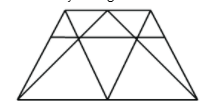
How many triangles are there in the given figure?