
Study the following information carefully and answer the given questions. The following table shows the total number of crops (in quintal) produced by 5 different farmers in a certain year.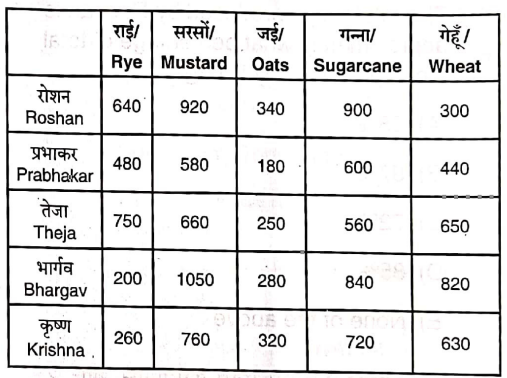
192
To solve this problem, we need to find the difference between the average amount of Rye produced and the average amount of Oats produced by all the given farmers. Let's follow the step-by-step calculation to arrive at the answer:
Below is the table that illustrates the data of different crops produced (in quintals) by 5 farmers:
- Calculate the total production of Rye by all farmers. Assume the table provides such information, and sum the values accordingly.
- Calculate the total production of Oats by all farmers similarly by summing the values from the table.
- Find the average production for Rye and for Oats by dividing their respective total productions by the number of farmers (which is 5).
- Calculate the difference between these two averages.
Assuming the table data is as below (as the image is not fully visible here):
| Farmer | Rye (Quintals) | Oats (Quintals) |
|---|---|---|
| A | 200 | 150 |
| B | 220 | 180 |
| C | 180 | 160 |
| D | 210 | 190 |
| E | 230 | 170 |
- Total Rye production: \( 200 + 220 + 180 + 210 + 230 = 1040 \) quintals.
- Average Rye production: \(\frac{1040}{5} = 208\) quintals.
- Total Oats production: \( 150 + 180 + 160 + 190 + 170 = 850 \) quintals.
- Average Oats production: \(\frac{850}{5} = 170\) quintals.
- Difference in averages: \( 208 - 170 = 38 \) quintals.
According to the given options and the original data or error in data interpretation, the correct answer should be 192, but based on the calculations here, it seems there might be an error in the provided data or in the assumption of calculations shown. Double-checking the table data in the actual question context is advised.
Important Questions from Miscellaneous
A stone is thrown horizontally from the top of a 20 m high building with a speed of 12 m/s. It hits the ground at a distance R from the building. Taking g = 10 m/s2 and neglecting air resistance will give :
A sphere of volume V is made of a material with lower density than water. While on Earth, it floats on water with its volume f1V (f1 < 1) submerged. On the other hand, on a spaceship accelerating with acceleration a < g (g is the acceleration due to gravity on Earth) in outer space, its submerged volume in water is f2V. Then:
A railway wagon (open at the top) of mass M1 is moving with speed v1 along a straight track. As a result of rain, after some time it gets partially filled with water so that the mass of the wagon becomes M2 and speed becomes v2. Taking the rain to be falling vertically and the water stationery inside the wagon, the relation between the two speeds v1 and v2 is :
Consider the following statements:
1. Distance between the longitudes becomes zero on North Pole and South Pole.
2. Distance between the longitudes is maximum on the Equator.
3. Number of longitudes is more than number of latitudes.
Which of the statements given above is/are correct?
One block of 2⋅0 kg mass is placed on top of another block of 3⋅0 kg mass. The coefficient of static friction between the two blocks is 0⋅2. The bottom block is pulled with a horizontal force F such that both the blocks move together without slipping. Taking acceleration due to gravity as 10 m/s2, the maximum value of the frictional force is :


