
Question
Find out the number of triangles in the given figure.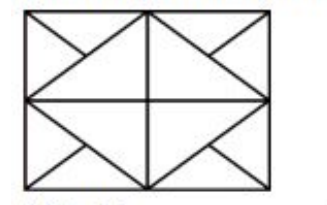
The correct answer is
20
To determine the number of triangles in the given figure, we will count them step-by-step, categorizing by their size and formation within the diagram.
- Observe the diagram carefully. It is a rectangle divided into several smaller triangles.
- Identify all the smallest triangles first:
- Count the triangles formed by the intersection of diagonal lines (let's call these smallest triangles). These are typically the sections directly divided within larger triangles. In total, there are 16 smaller triangles visible within the subdivisions.
- Count the larger triangles formed by combining two or more smaller triangles:
- Triangles formed by joining two adjacent small triangles within a bigger rectangle or section.
- There are 4 such large triangles at each intersection, resulting in another 4 distinct triangles for this step.
- Consider any even larger triangles:
- These can be formed by combining the smaller triangles either horizontally or vertically across the structure.
- Add up all the triangles identified:
- 16 (smallest triangles) + 4 (larger triangles) = 20 triangles in total.
Thus, the total number of triangles in the figure is \(20\).
Was this answer helpful?
Important Questions from Counting Figures
How many triangles are there in the given figure?

Find the number of squares in the given figure. ( Rectangles NOT to be included ).
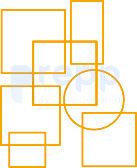
Find the number of triangles in the given figure.
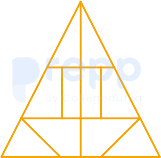
How many triangles are there in the question figure?
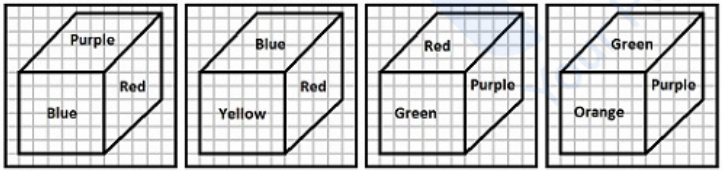
In the given cubes, which colour is opposite to purple?
Need Expert Advice?


