
Understanding State Monopoly in Foreign Trade
The question asks for the term that describes the establishment of a state monopoly in foreign trade. This means that the government, rather than private businesses, is the sole entity allowed to conduct international trade operations.
Defining Canalisation
Canalisation is a trade policy where the government restricts foreign trade to specified channels or agencies, often establishing a state monopoly. This means all imports or exports must go through designated government bodies or state-controlled enterprises.
- It grants the state exclusive control over specific aspects of foreign trade.
- This is done to manage foreign exchange, protect domestic industries, or achieve specific economic goals.
- The term directly applies to the situation described in the question where the state establishes a monopoly.
Analyzing Other Options
Let's look at why the other options are not the best fit:
- Quota agreement: This involves setting limits (quotas) on the quantity of specific goods that can be imported or exported. It doesn't necessarily establish a state monopoly but restricts volumes.
- Anti-dumping: This refers to measures taken against dumping, which is when a country exports goods at a price lower than their domestic market price or production cost. It's a protective measure, not a system of state monopoly.
- Free trade: This is the opposite of a state monopoly. Free trade involves minimal government restrictions, allowing goods and services to be bought and sold across international borders with little to no tariffs, quotas, or other barriers.
Conclusion on Foreign Trade Monopoly
Based on the definitions, canalisation is the correct term for establishing a state monopoly in foreign trade, as it implies directing and controlling trade through state channels.
Important Questions from Miscellaneous
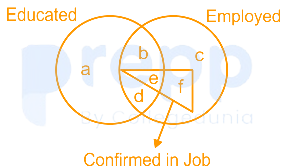
Read the given figure and find the region representing persons who are educated and employed but not confirmed in job.
The magazine in which Mahatma Gandhi mentioned what he wanted the Constitution to do is:
Which gas shields the surface of the earth from ultraviolet radiation from the sun?
Which event is marked as an Intangible Cultural Heritage of Humanity by UNESCO?
Who has been conferred with the rank of the Commander of the Order of the British Empire in 2018?


