
Developmental changes in children are
a complex interaction between hereditary and environmental factors
Child development is shaped by both nature and nurture. Heredity sets the potential for growth through genes, while the environment (nutrition, family, school, culture and language) decides how far and in what way that potential is realised.
Developmental psychologists such as Bronfenbrenner and Vygotsky stress that these influences interact continuously, so development is multidimensional, varies from child to child and from culture to culture, and cannot be explained by either factor alone.
Development is not universal at the same pace everywhere, since rates differ across individuals and cultures. It is not unidimensional or strictly linear, because physical, cognitive, social and emotional changes proceed together and unevenly. It follows the cephalocaudal principle, from head to toe, not from toe to head.
a complex interaction between hereditary and environmental factors option is correct.
Similar Questions
The value of the expression \((-3)^3 \times (0.3)^{-2} \times 0.01\) lies between which of the following ranges?
In a class test, a student earns 3 marks for every correct answer and loses 2 marks for every incorrect answer. No marks are given for questions left unattempted. If Radhika scored 20 marks and had 12 correct answers, how many questions did she attempt incorrectly?
If a polyhedron has 6 faces and 12 edges, what is the number of its vertices?
If \(a\) and \(b\) are positive integers (where \(b \neq 0\)) such that \(a^b = 1331\), then what is the value of \((a+b)^{a-b-8}\)?
Numbers that can be expressed as the sum of two cubes in two different ways are known as:
If \(x + \dfrac{y}{2} = \dfrac{1}{4}\), \(y + \dfrac{z}{2} = \dfrac{1}{4}\) and \(z + \dfrac{x}{2} = \dfrac{1}{4}\), then what is the value of \(x + y + z\)?
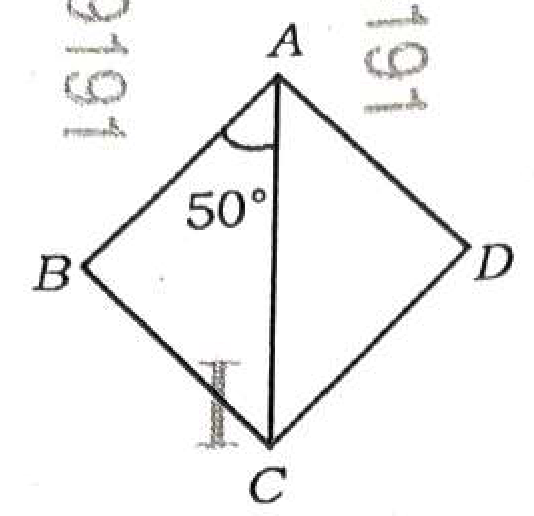
ABCD is a rhombus in which \(\angle BAC = 50^\circ\). What is the value of \(3\angle D - 2\angle DAC\)?
What is the value of \(\dfrac{\sqrt{450}}{\sqrt{338}} \div \dfrac{\sqrt{125}}{\sqrt{245}}\)?
The selling price of a toy is Rs. 1,020. If the profit made by the shopkeeper is 20%, what is the cost price of the toy?
The denominator of a rational number is greater than its numerator by 4. If 1 is added to both the numerator and the denominator, the resulting fraction is \(\dfrac{1}{2}\). Find the rational number.
Important Questions from Mixed Topic (JTET)
What type of process is thinking ?
The normal cause of origin of motivation is
How is impulse important for a teacher ?
The motive which forms due to social ideals, status, relations etc. is called
The learning in children starts from



