
Determine the value of current (in A) through both the resistors of the given circuit.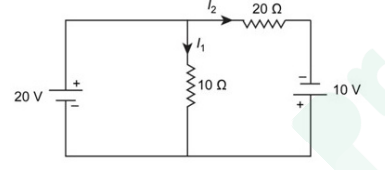
To determine the current through both resistors in the given circuit, we need to apply Kirchhoff's Voltage Law (KVL) and Ohm's Law.
Step 1: Identify the Loops
- Loop 1 (left loop): Includes the 20 V battery and the 10 Ω resistor.
- Loop 2 (right loop): Includes the 10 V battery and the 20 Ω resistor.
Step 2: Apply Kirchhoff's Voltage Law (KVL) to Loop 1
The sum of voltages around Loop 1 is:
\(20 - 10I_1 = 0\)
Simplifying, we find:
\(I_1 = 2 \, \text{A}\)
Step 3: Apply Kirchhoff's Voltage Law (KVL) to Loop 2
The sum of voltages around Loop 2 is:
\(-10 + 20I_2 = 0\)
Simplifying, we find:
\(I_2 = 0.5 \, \text{A}\)
Step 4: Use Node Analysis at the Junction
At the junction where the currents meet, using Kirchhoff's Current Law (KCL), we have:
\(I_1 = I_2 + I_3\)
Since \(I_1 = 2\) A and \(I_2 = 0.5\) A, the current through the 10 Ω resistor (denoted as \(I_3\)), we solve:
\(2 = 0.5 + I_3\)
Thus,
\(I_3 = 1.5 \, \text{A}\)
Conclusion:
The currents through the resistors are \(I_1 = 2\) A and \(I_3 = 1.5\) A.
Therefore, the correct answer is 2, 1.5.
Important Questions from Kirchhoff's Laws
______ finds the voltage potentials at different nodes that provide a common connection for two or more circuit components in a circuit.
How many equations are necessary to solve a circuit with two principal nodes?
A 40 Ω resistor is in parallel with an 80 Ω resistor. Current in the 40 Ω resistor is 6 A. How will you add a third resistor and what will be its value if the line-current is to be 10 A?
Kirchoff's first law states that at a junction in an electric circuit -
Kirchhoff's current law is based on the conservation of


