
Determine the Thevenin's equivalent resistance (in ohms) across terminals A and B for the electrical circuit given below.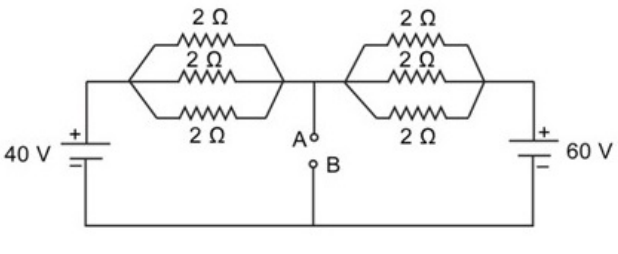
To determine the Thevenin's equivalent resistance across terminals A and B, we need to follow these steps:
- Remove any independent sources present in the circuit. This involves shorting voltage sources and opening current sources. In this circuit, short the 40V and 60V sources.
- Redraw the circuit with the isolated terminals A and B:
- Calculate the equivalent resistance between terminals A and B:
- The 2Ω resistors are in parallel in their respective branches. The equivalent resistance for each parallel combination is calculated using the formula:
- \(R_{\text{eq, parallel}} = \frac{1}{\frac{1}{2} + \frac{1}{2}} = 1 \text{ Ω}\)
- Each set of parallel resistors (both left and right clusters) reduces to 1Ω, so you now have two 1Ω resistors in series when terminals A and B are considered open:
- \(R_{\text{series}} = 1 + 1 = 2 \text{ Ω}\)
- The two series 2Ω resistances are in parallel with the open terminals:
- The overall Thevenin resistance is given by:
- \(R_{\text{th}} = \frac{1}{\frac{1}{2} + \frac{1}{2}} = 0.33 \text{ Ω}\)
- Hence, the Thevenin's equivalent resistance across terminals A and B is \(0.33 \text{ Ω}\).
Therefore, the correct answer is \(0.33 \text{ Ω}\).
Important Questions from Thevenin's Theorem
- A Norton equivalent circuit consists of a 100 μA current source in parallel with a 10 kΩ resistance. If this is converted into a Thevenin equivalent, how much is V Th ?
______ is an analytical method used to change a complex circuit into a simple equivalent circuit consisting of a single resistance in series with a source voltage.
If Thevenin's voltage is 89.3 volts and Thevenin's resistance is 46.98 ohms then what will be the maximum power delivered to the load present in the network?
Which of the following theorem states that "a linear two-terminal circuit can be replaced by an equivalent circuit consisting of a voltage source VTH in series with a resistor RTH", where VTH is the open circuit voltage at the terminals and RTH is the input or equivalent resistance at the terminals, when the independent sources are turned off
For finding Thevenin equivalent circuit, the Circuit Current Sources have been replaced by:


