
Determine the root means square value (in V) of the voltage waveform given in the figure below.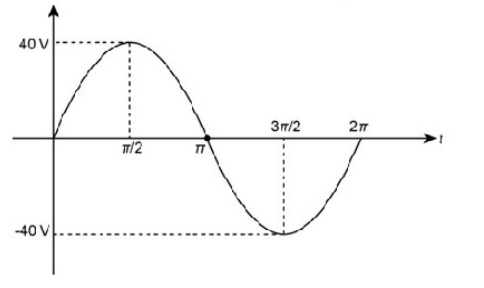
The root mean square (RMS) value of a periodic waveform is calculated to find the effective value of the waveform. For sinusoidal waveforms, the RMS value can be derived from its maximum value (peak value).
Given a sinusoidal waveform, the RMS value is calculated using the formula:
V_{\text{rms}} = \frac{V_{\text{max}}}{\sqrt{2}}
From the waveform, the maximum voltage V_{\text{max}} is 40 V.
Substitute the value into the formula:
V_{\text{rms}} = \frac{40}{\sqrt{2}}
Simplify the expression:
V_{\text{rms}} = \frac{40}{1.414} \approx 28.29 \, \text{V}
Thus, the RMS value of the voltage waveform is 28.29 V.
Among the given options, the correct answer is:
This option matches the calculated RMS value.
Important Questions from Sinusoidal Steady State Analysis
The total opposition offered to the flow of current in AC circuit is called-
A quantity whose magnitude has a definite repeating time cycle is called a-
The current drawn by a tungsten filament lamp is measured by an ammeter. The ammeter reading under steady state condition will be ______ the ammeter reading when the supply is switched on.
The current flowing through a pure inductor in an AC circuit lags the applied voltage by:
What is the average value of a sine wave Vm sinωt over a full cycle?


