
Consider the following statements:
Statement I: All booklets are manuals
Statement II: All manuals are Catalogues
If statements I and II are true, then which of the following conclusions can be definitely drawn?
All booklets are Catalogues
Booklet Manual Catalogue Logic Explained
This question requires us to use logical reasoning, specifically the principles of syllogisms, to determine what conclusion necessarily follows from two given statements. We need to check which of the provided options is a valid inference.
Statement I: Booklets and Manuals Relationship
Statement I states: All booklets are manuals.
This implies that the entire category of 'booklets' is included within the larger category of 'manuals'. If any item is identified as a booklet, it must also be a manual. We can represent this relationship using set theory, where the set of booklets ($B$) is a subset of the set of manuals ($M$):
$ B \subseteq M $
Alternatively, using logical implication:
$ \text{If something is a booklet, then it is a manual.} $
Statement II: Manuals and Catalogues Relationship
Statement II states: All manuals are Catalogues.
Similarly, this means that the entire category of 'manuals' is included within the category of 'Catalogues'. If any item is a manual, it must also be a catalogue. In set notation, the set of manuals ($M$) is a subset of the set of Catalogues ($C$):
$ M \subseteq C $
Or, using logical implication:
$ \text{If something is a manual, then it is a Catalogue.} $
Deriving the Conclusion: Booklets to Catalogues
To find the conclusion that can be definitely drawn, we combine the information from both statements. We have a logical chain:
- Statement I establishes: If something is a booklet, it is a manual ($B \implies M$).
- Statement II establishes: If something is a manual, it is a catalogue ($M \implies C$).
This structure allows us to apply the transitive property of logic. If being a booklet implies being a manual, and being a manual implies being a catalogue, then being a booklet must imply being a catalogue.
The transitive relationship can be shown as:
$ \text{If } B \implies M \text{ and } M \implies C, \text{ then } B \implies C $
Using set notation, this is also evident:
$ \text{If } B \subseteq M \text{ and } M \subseteq C, \text{ then } B \subseteq C $
Therefore, the definite conclusion derived from the two statements is: All booklets are Catalogues.
Evaluating the Inference Options
We now check each option against our derived conclusion:
- Option 1: All manuals are booklets. This is the converse of Statement I ($M \implies B$). Statement I ($B \implies M$) does not logically imply its converse.
- Option 2: All Catalogues are booklets. This is the converse of our derived conclusion ($C \implies B$). Our conclusion ($B \implies C$) does not imply its converse.
- Option 3: All booklets are Catalogues. This directly matches the conclusion we derived using the transitive property ($B \implies C$).
- Option 4: All Catalogues are manuals. This is the converse of Statement II ($C \implies M$). Statement II ($M \implies C$) does not logically imply its converse.
Based on this analysis, the only conclusion that can be definitively drawn is that all booklets are Catalogues.
Important Questions from Syllogism (Notes)
- Disregard commonly known facts. Which conclusion would follow on the basis of given statements only.
Statement: Some bottles are car. some cars are cycle.
Conclusion:
(I) Some bottles are cycle is a possibility
(II) All bottles are cycle
In light of the above statements, choose the most appropriate answer from the options given below. Take the given statements to be true even if they seem to be at variance with commonly known facts. Then decide which of the given conclusions logically follow the given statements.
Statements :
0% chairs are tables.
All computers are chairs.
Some books are tables.
Conclusions :
I. Not a single table is a computer.
II. Some books are not chairs.
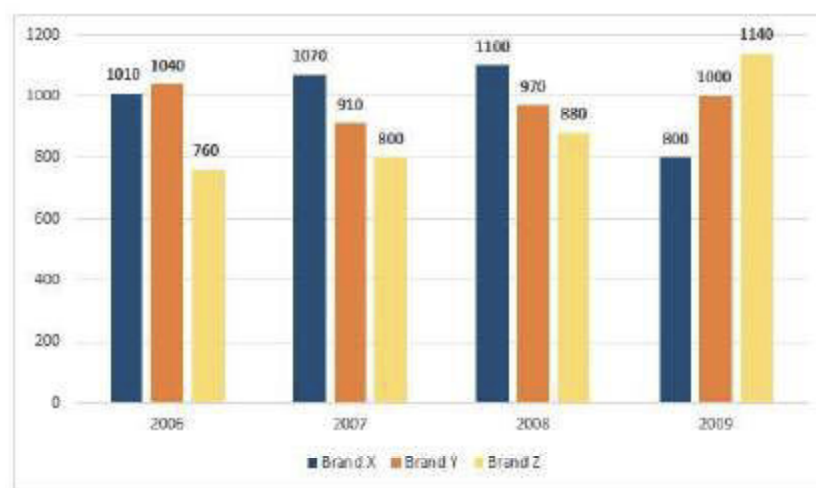
Directions: Study the following Bar-chart and the data provided to answer the questions that follow: Sales of 3-different companies selling T-Shirts for the years from 2006 to 2009 are given. How much percentage of sales decreased for Brand X T-shirt in 2009 compared with 2007?
Statements:
All herbivores are carnivores.
Some carnivores are omnivores.
Conclusions:
i) Some herbivores are omnivores.
ii) Some carnivores are herbivores.
Statements:
All sweets are snacks.
All snacks are crisps.
All crisps are tasty.
Conclusions:
i) All sweets are crisps.
ii) All snacks are tasty.


