
Consider the following statements: Assertion (A): Teachers should use standardised IQ tests to measure children's intelligence. Reason (R): Standardised IQ tests can predict intelligence accurately. Choose the correct option:
Both (A) and (R) are false
Intelligence is now understood as many-sided and shaped by culture and context. Howard Gardner's theory of multiple intelligences and Sternberg's triarchic theory show that a single score cannot capture a child's abilities, and NCF 2005 and NEP 2020 ask teachers to rely on continuous, comprehensive and competency-based assessment rather than labelling children with test scores.
Assertion (A) is false. A classroom teacher's job is to understand each learner through observation, portfolios, projects and varied tasks. Using standardised IQ tests to measure children's intelligence encourages labelling and comparison, and such tests are often biased towards particular languages and cultural experiences, so teachers should not depend on them.
Reason (R) is also false. IQ tests measure only a narrow band of abilities such as verbal and logical-mathematical reasoning, scores vary with test conditions, motivation and background, and they cannot predict a child's intelligence accurately. Because both statements are false, the options that treat the Assertion as true, with or without the Reason as an explanation, do not hold.
Both (A) and (R) are false option is correct.
Similar Questions
The value of the expression \((-3)^3 \times (0.3)^{-2} \times 0.01\) lies between which of the following ranges?
In a class test, a student earns 3 marks for every correct answer and loses 2 marks for every incorrect answer. No marks are given for questions left unattempted. If Radhika scored 20 marks and had 12 correct answers, how many questions did she attempt incorrectly?
If a polyhedron has 6 faces and 12 edges, what is the number of its vertices?
If \(a\) and \(b\) are positive integers (where \(b \neq 0\)) such that \(a^b = 1331\), then what is the value of \((a+b)^{a-b-8}\)?
Numbers that can be expressed as the sum of two cubes in two different ways are known as:
If \(x + \dfrac{y}{2} = \dfrac{1}{4}\), \(y + \dfrac{z}{2} = \dfrac{1}{4}\) and \(z + \dfrac{x}{2} = \dfrac{1}{4}\), then what is the value of \(x + y + z\)?
ABCD is a rhombus in which \(\angle BAC = 50^\circ\). What is the value of \(3\angle D - 2\angle DAC\)?
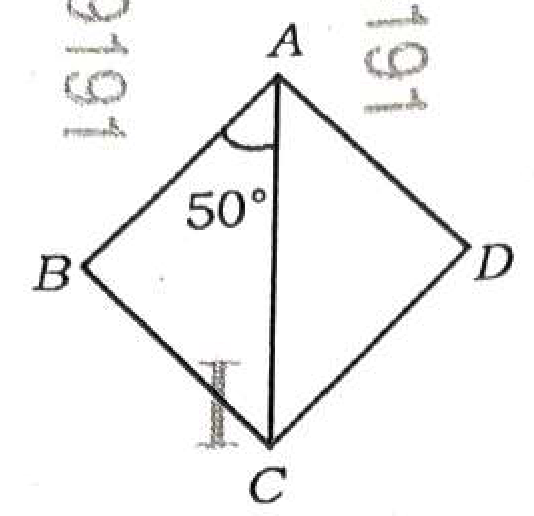
What is the value of \(\dfrac{\sqrt{450}}{\sqrt{338}} \div \dfrac{\sqrt{125}}{\sqrt{245}}\)?
The selling price of a toy is Rs. 1,020. If the profit made by the shopkeeper is 20%, what is the cost price of the toy?
The denominator of a rational number is greater than its numerator by 4. If 1 is added to both the numerator and the denominator, the resulting fraction is \(\dfrac{1}{2}\). Find the rational number.
Important Questions from Mixed Topic (JTET)
What type of process is thinking ?
The normal cause of origin of motivation is
How is impulse important for a teacher ?
The motive which forms due to social ideals, status, relations etc. is called
The learning in children starts from



