
Consider the following statements: Assertion (A): A child has to have some neuromotor maturation as he learns to catch a ball. Reason (R): Learning is dependent upon development.
Both (A) and (R) are true and (R) is the correct explanation of (A)
Learning and development are closely linked. Development, especially maturation of the nervous system and muscles, creates readiness, and learning builds on that readiness. Arnold Gesell's maturation studies showed that training given before the necessary maturation produces little gain, while the same training after maturation is learned quickly.
Assertion (A) is true. Catching a ball needs eye-hand coordination, timing, grip and balance, all of which depend on neuromotor maturation; a toddler whose motor system is not yet mature cannot learn to catch however much practice is given.
Reason (R) is also true: learning is dependent upon development, since a child can acquire a skill only when the required physical and mental capacities have developed. This general principle is exactly why neuromotor maturation is needed before a child learns to catch a ball, so (R) correctly explains (A). The options that call either statement false, or that deny the explanatory link, are therefore wrong.
Both (A) and (R) are true and (R) is the correct explanation of (A) option is correct.
Similar Questions
The value of the expression \((-3)^3 \times (0.3)^{-2} \times 0.01\) lies between which of the following ranges?
In a class test, a student earns 3 marks for every correct answer and loses 2 marks for every incorrect answer. No marks are given for questions left unattempted. If Radhika scored 20 marks and had 12 correct answers, how many questions did she attempt incorrectly?
If a polyhedron has 6 faces and 12 edges, what is the number of its vertices?
If \(a\) and \(b\) are positive integers (where \(b \neq 0\)) such that \(a^b = 1331\), then what is the value of \((a+b)^{a-b-8}\)?
Numbers that can be expressed as the sum of two cubes in two different ways are known as:
If \(x + \dfrac{y}{2} = \dfrac{1}{4}\), \(y + \dfrac{z}{2} = \dfrac{1}{4}\) and \(z + \dfrac{x}{2} = \dfrac{1}{4}\), then what is the value of \(x + y + z\)?
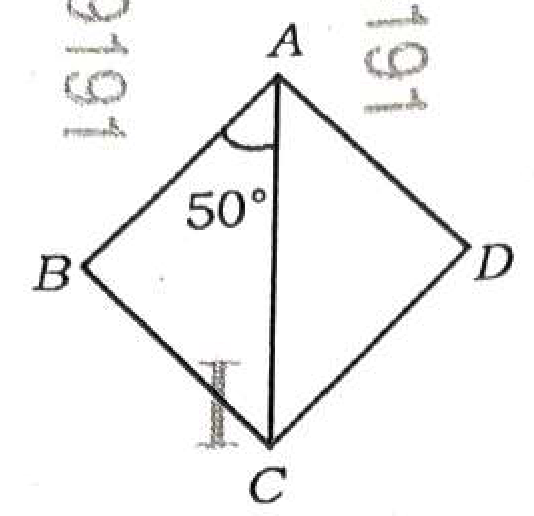
ABCD is a rhombus in which \(\angle BAC = 50^\circ\). What is the value of \(3\angle D - 2\angle DAC\)?
What is the value of \(\dfrac{\sqrt{450}}{\sqrt{338}} \div \dfrac{\sqrt{125}}{\sqrt{245}}\)?
The selling price of a toy is Rs. 1,020. If the profit made by the shopkeeper is 20%, what is the cost price of the toy?
The denominator of a rational number is greater than its numerator by 4. If 1 is added to both the numerator and the denominator, the resulting fraction is \(\dfrac{1}{2}\). Find the rational number.
Important Questions from Mixed Topic (JTET)
What type of process is thinking ?
The normal cause of origin of motivation is
How is impulse important for a teacher ?
The motive which forms due to social ideals, status, relations etc. is called
The learning in children starts from



