
Consider the following statement: In adversarial search, $\alpha-\beta$ pruning can be applied to game trees of any depth where $\alpha$ is the (m) value choice we have formed so far at any choice point along the path for the MAX player and $\beta$ is the (n) value choice we have formed so far at any choice point along the path for the MIN player. Which ONE of the following choices of (m) and (n) makes the above statement valid?
Understanding Alpha-Beta Pruning Values
$\alpha-\beta$ pruning is an optimization technique for the minimax algorithm used in adversarial search (like in game playing). It reduces the number of nodes evaluated in the search tree. The algorithm uses two values, $\alpha$ and $\beta$, to keep track of the best options available along the path.
Defining $\alpha$ and $\beta$
- $\alpha$ (Alpha): Represents the best (maximum) value found so far for the MAX player. MAX wants to maximize the score, so $\alpha$ tracks the highest score MAX is guaranteed to achieve.
- $\beta$ (Beta): Represents the best (minimum) value found so far for the MIN player. MIN wants to minimize the score, so $\beta$ tracks the lowest score MIN is guaranteed to achieve.
Matching Values to the Statement
The statement describes $\alpha$ and $\beta$ in the context of choices made so far:
- For the MAX player, $\alpha$ is the highest value choice found so far (filling blank m).
- For the MIN player, $\beta$ is the lowest value choice found so far (filling blank n).
Therefore, the correct choices are (m) = highest and (n) = lowest.
Important Questions from Adversarial Search
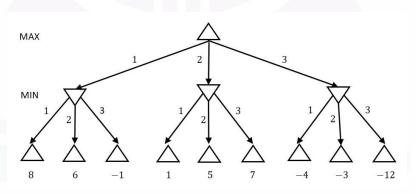
Consider the game tree for a two-player turn-taking minimax game as shown in the figure. The value of a terminal node represents the utility of the game state if the game ends there. The numbers written next to the edges denote the strategies.
There are two players MAX and MIN. At any particular state of the game, MAX prefers to move to a state of maximum value. On the other hand, MIN prefers to move to a state of minimum value.
Suppose MAX starts the game at the root and has three strategies: 1, 2 and 3.
Next, MIN plays and also has three strategies: 1, 2 and 3. The game ends there.
Both players always take optimal strategies throughout the game.
At the root, the best strategy for MAX is ___________ . (Answer in integer)
Consider game trees Tree-1 and Tree-2 as shown. The first level is a MAX agent and the second level is a MIN agent. The value in the square node is the output of the utility function.
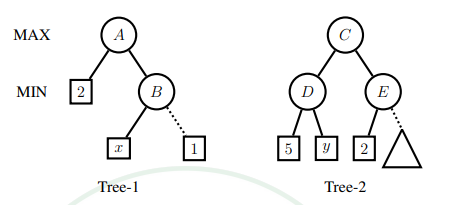
For what ranges of $x$ and $y$, the right child of node $B$ and the right child of node $E$ will be pruned by alpha-beta pruning algorithm?


