
Consider the following diagram showing the market demand and supply curves for a commodity. If the government fixes the price P1 above the market clearing price P0, then the dead-weight loss is represented by :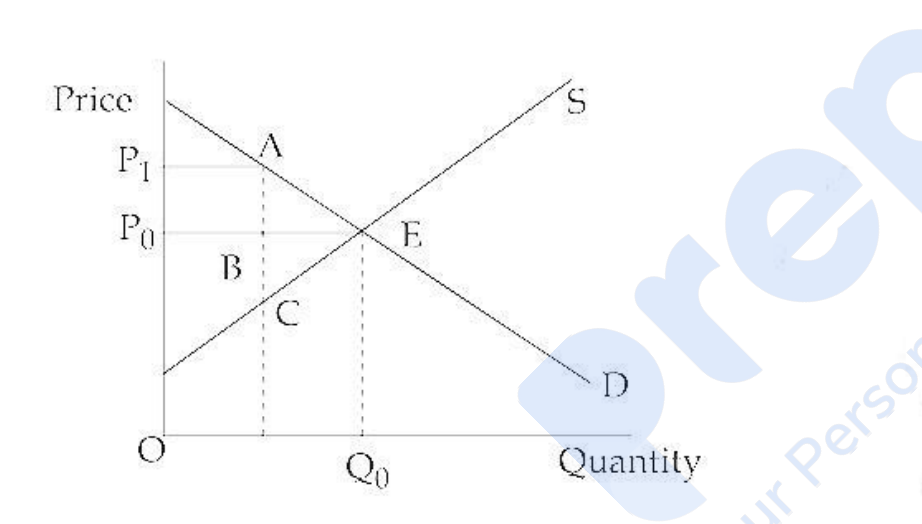
To solve the problem, we need to understand the concept of deadweight loss in the context of price ceilings or floors. In the given diagram, the market clearing price, where the demand and supply curves intersect, is at \(P_0\). However, the government has fixed the price at \(P_1\), which is above this equilibrium price.
When the price is set above the equilibrium price, it leads to a surplus in the market since the quantity supplied exceeds the quantity demanded. The deadweight loss, in this case, is the loss in total welfare or efficiency from not trading the equilibrium quantity.
Look at the areas marked in the diagram:
- Triangle ABE represents the loss in consumer surplus because consumers are purchasing less at a higher price.
- Triangle EBC represents the loss in producer surplus because producers are selling less, even though they could have sold more at a lower price.
The deadweight loss is the combined loss in consumer and producer surplus due to the reduction in quantity traded from \(Q_0\) to a lower quantity (let’s say \(Q_1\)), which is represented by the area of triangle ABE plus the area of triangle EBC.
Therefore, the correct answer is the Area of triangle ABE + area of triangle EBC.
Important Questions from Microeconomics
Which of the following statement is correct?
I. Indifference curves are sloping from left to right.
II. Higher indifference curve gives a higher level of utility.
If in a production process, all inputs are tripled, which of the following statements follows?
I. If the output is tripled, then decreasing returns to scale apply.
II. When the output is doubled, constant returns to scale apply.
III. If the output is more than tripled, then increasing returns to scale apply.
When it is not possible to make someone good without harming someone, then such a situation is called
According to Ricardo what condition is necessary to make possible international trade between two countries?
Match List I with List II:
List- I
Shape of revenue curve of the firm
List – II
Market structure
A.
Kinked revenue-curve (I)
Monopolistic competition B.
Infinitely elastic straight line curve (II)
Perfect competition C.
Relatively less elastic curve (III)
Oligopoly D.
Relatively high elastic curve (IV)
Monopoly.
Choose the correct answer from the options given below -


