
Consider the control system block diagram given in Figure (a). The loop transfer function $G(s)H(s)$ does not have any pole on the $j\omega$ -axis. The counterclockwise contour with infinite radius, as shown in Figure (b), encircles two poles of $G(s)H(s)$. Choose the correct statement from the following options for closed loop stability of the system.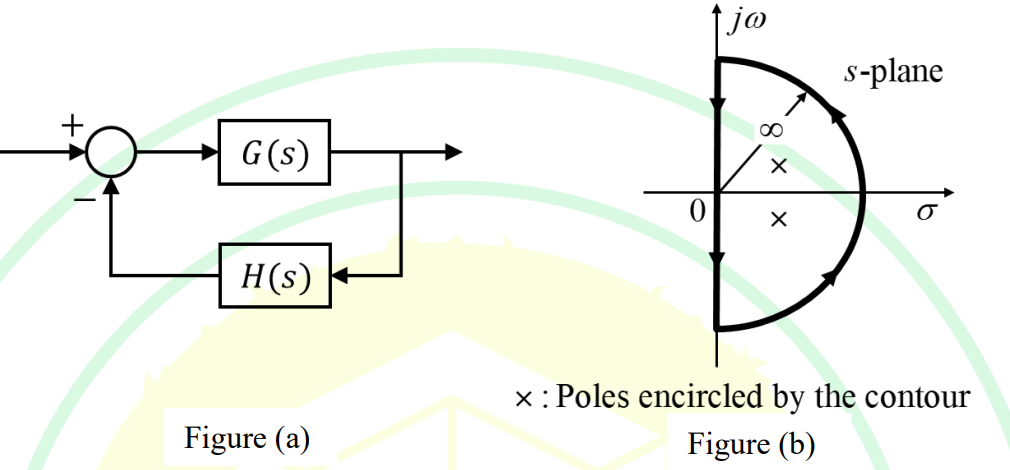
To determine the closed-loop stability of the control system described, we use the Nyquist stability criterion. The key points to understand are:
- The Closed-Loop Transfer Function: For a unity feedback system, the closed-loop transfer function is given by: \(\frac{G(s)}{1 + G(s)H(s)}\).
- The Nyquist Criterion: This criterion uses the open-loop transfer function \(G(s)H(s)\) to evaluate the stability of the closed-loop system. According to the criterion, if a contour in the s-plane encircles \(P\) poles of \(G(s)H(s)\), the contour in the Nyquist plot of \(1 + G(s)H(s)\) must encircle the point \(-1 + j0\) \(N\) times in the clockwise direction to achieve \(Z = P + N\), where \(Z\) is the number of poles in the right-half plane.
Given the information:
- The contour encloses two poles of \(G(s)H(s)\).
- There are no poles of \(G(s)H(s)\) on the \(j\omega\)-axis.
Applying Nyquist Criterion:
- Since there are two poles of \(G(s)H(s)\) inside the contour, \(P = 2\).
- For the system to be stable, the Nyquist plot of \(1 + G(s)H(s)\) must encircle the origin \(2\) times in the clockwise direction, which implies \(N = -2\) (since being clockwise is considered negative in Nyquist plots).
Thus, the correct statement is: The locus of \(1+G(s)H(s)\) should encircle the origin twice in the clockwise direction.
Important Questions from Nyquist Plot
______indicates not only whether a system is stable, but also its degree of stability and how stability may be imposed if necessary.
In Nyquist plot of a system on adding a pole at s = 0, then plot will -
The Nyquist plot of the transfer function \(G\left( s \right) = \frac{K}{{\left( {{s^2} + 2s + 2} \right)\left( {s + 2} \right)}}\)
Does not encircle the point (–1 + j0) for K = 10 but does encircle the point (-1 + j0) for K = 100 . Then the closed-loop system (having unity gain feedback) is
A closed-loop control system is stable if the Nyquist plot of the corresponding open-loop transfer function
The Nyquist stability criterion and the Routh criterion both are powerful analysis tools for determining the stability of feedback controllers. Identify which of the following statements is FALSE:


