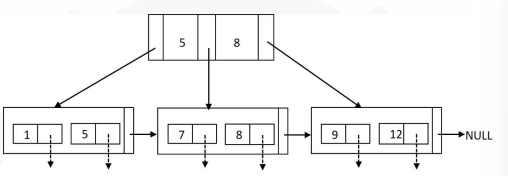
The question asks for the minimum number of keys in a non-root node of a B+ tree, given that the maximum number of keys in a node is 5.
Understanding B+ Tree Properties
In a B+ tree, the structure is balanced, and nodes have specific rules regarding the number of keys and children:
- Let $m$ be the maximum number of children a node can have (order of the tree).
- The maximum number of keys a node can hold is $m - 1$.
- The minimum number of keys in a non-root node is $ceil(m / 2) - 1$.
- The minimum number of keys in the root node is 1 (unless it's the only node).
Calculating Minimum Keys
We are given that the maximum number of keys in a node is 5.
Using the property $Maximum keys = m - 1$:
$5 = m - 1$
Solving for $m$, we get:
$m = 5 + 1 = 6$
So, the maximum number of children a node can have is 6.
Now, we calculate the minimum number of keys required in any non-root node using the formula $Minimum keys = ceil(m / 2) - 1$:
$ \text{Minimum keys} = \lceil \frac{6}{2} \rceil - 1 $
$ \text{Minimum keys} = \lceil 3 \rceil - 1 $
$ \text{Minimum keys} = 3 - 1 = 2 $
Therefore, the minimum number of keys in any non-root node is 2.
Important Questions from Indexing
Primary index in sequential order file organisation is also known as ______.
A B-tree used as an index for a large database table has four levels including the root node. If a new key is inserted in this index, then maximum number of nodes that could be newly created in the process is
The total cost of retrieving records in sorted order using an unclustered B+ tree is
(P-Average number of records per data page
N-Data pages
F-Ratio of the size of a data entry to the size of a data record)
- In a relational database, a B+ Tree Index is to be constructed for a relation on a key field. In a B+ Tree, a Node Pointer points to a sub-tree and a Data Record Pointer points to a block of database records.
Let, Node size = 4096 bytes, Node Pointer size = 10 bytes, Search Key Field size = 11 bytes and Data Record Pointer size = 12 bytes.
The maximum number of Node Pointers that can be present in a non-leaf node of the B+ Tree is ________ . (Answer in integer) Consider a B+ Tree where the maximum number of key values in each leaf node is 2 and the maximum number of pointers in each non-leaf node is 3. Let the content of the B+ Tree be as shown in the figure.
Which of the following options denotes the key value(s) stored in the root node after inserting a key value 3 in the given B+ Tree?