
Consider an additive white Gaussian noise (AWGN) channel with bandwidth W and noise power spectral density $\frac{N_0}{2}$. Let $P_{av}$ denote the average transmit power constraint. Which one of the following plots illustrates the dependence of the channel capacity C on the bandwidth W (keeping $P_{av}$ and $N_0$ fixed)?
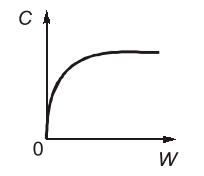
Understanding Channel Capacity Dependence on Bandwidth
The question asks how the channel capacity (C) of an Additive White Gaussian Noise (AWGN) channel changes with bandwidth (W), given fixed average transmit power ($P_{av}$) and noise power spectral density ($N_0$).
Shannon-Hartley Theorem for AWGN Channels
The channel capacity for an AWGN channel is defined by the Shannon-Hartley theorem:
$ C = W \log_2 \left( 1 + \frac{P_{av}}{N_0 W} \right) $
Here:
- \( C \) is the channel capacity in bits per second (bps).
- \( W \) is the channel bandwidth in Hertz (Hz).
- \( P_{av} \) is the average transmit power.
- \( N_0 \) is the one-sided noise power spectral density.
Analyzing the Relationship Between C and W
We need to examine how \( C \) behaves as \( W \) varies, assuming \( P_{av} \) and \( N_0 \) are constant.
Consider the term inside the logarithm: \( \frac{P_{av}}{N_0 W} \). As the bandwidth \( W \) increases, this term decreases.
Let's look at two limiting cases:
- Small Bandwidth (W → 0): When \( W \) is very small, \( \frac{P_{av}}{N_0 W} \) becomes very large. Using the approximation \( \log_2(1+x) \approx \frac{x}{\ln(2)} \) for large \( x \), we get \( C \approx W \times \frac{P_{av}}{N_0 W \ln(2)} = \frac{P_{av}}{N_0 \ln(2)} \). This indicates that for small W, C approaches a finite value proportional to \( P_{av} / (N_0 \ln(2)) \) as W increases.
- Large Bandwidth (W → ∞): When \( W \) is very large, \( \frac{P_{av}}{N_0 W} \) approaches 0. Using the approximation \( \log_2(1+x) \approx \frac{x}{\ln(2)} \) for small \( x \), we get \( C \approx W \times \frac{P_{av}}{N_0 W \ln(2)} = \frac{P_{av}}{N_0 \ln(2)} \). This shows that the capacity \( C \) approaches a finite upper limit, \( \frac{P_{av}}{N_0 \ln(2)} \), as \( W \) increases.
Conclusion on C vs W Plot
The channel capacity \( C \) starts at 0 when \( W=0 \). As \( W \) increases, \( C \) increases but at a decreasing rate, eventually approaching a constant maximum value. This behavior corresponds to a curve that rises and then flattens out, indicating diminishing returns from increasing bandwidth.
The plot illustrating this relationship shows capacity C on the y-axis and bandwidth W on the x-axis, with the curve increasing initially and then becoming horizontal, approaching an asymptote.
Important Questions from Channel Capacity
The capacity of band-limited additive white Gaussian Noise (AWGN) channel is given by \(C = W{\log _2}\left[ {1 + \frac{P}{{{\sigma ^2}w}}} \right]\) bits per second (bps), where W is the channel Bandwidth, P is the average power received and σ2 is the one-sided power spectral density of the AWGN.
For a fixed \(\frac{P}{{{\sigma ^2}}} = 1000\), the channel capacity (in kbps) with infinite Bandwidth (W → ∞) is approximately
- Let the relevant bandwidth ($B$) of a digital communication system be 1 MHz and $kT = -174\text{ dBm/Hz}$, where $k$ is Boltzmann's constant and '$T$' is equivalent noise temperature of the receiver. The power ($S$) of signal received through an additive Gaussian channel is $-80\text{ dBm}$.
Which of the following options is/are TRUE about Shannon capacity ($C$) of the channel? The information capacity (bits/sec.) of a channel with bandwidth W and transmission time T is given by
The Hartley law states that :
(a) the maximum rate of information depends on the channel bandwidth
(b) the maximum rate of information depends on the depth of modulationAccording to Hartley's law


