
Consider a watershed and isohyets as shown in the figure. The average rainfall in the watershed is _________ mm (an integer value).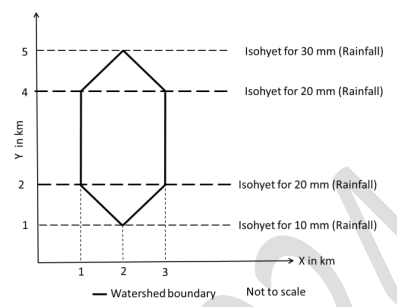
To calculate the average rainfall in the watershed, we use the method of isohyetal areas. The isohyets divide the watershed into zones, each with a specific rainfall value. We assume a linear variation of rainfall between the isohyets.
Step-by-step calculation:
Divide the watershed area into zones based on the isohyets:
- Zone 1: Between the isohyets for 10 mm and 20 mm.
- Zone 2: Between the isohyets for 20 mm and 30 mm.
Calculate the area of each zone:
- Zone 1: Trapezoidal shape from 1 km to 3 km; Height = 1 km to 2 km (1 km); Widths: 2 km (average width).
- Zone 2: Trapezoidal shape from 1 km to 3 km; Height = 2 km to 5 km (3 km); Widths: 2 km (average width).
Calculate the average rainfall for each zone:
- Zone 1: Average of 10 mm and 20 mm = 15 mm.
- Zone 2: Average of 20 mm and 30 mm = 25 mm.
Calculate the total weighted rainfall:
Total Rainfall = (Area of Zone 1 × Rainfall of Zone 1) + (Area of Zone 2 × Rainfall of Zone 2)
- Total Rainfall = (2 km2 × 15 mm) + (6 km2 × 25 mm)
- = 30 mm + 150 mm = 180 mm
Calculate the total area:
- Total Area = Area of Zone 1 + Area of Zone 2 = 2 km2 + 6 km2 = 8 km2
Calculate the average rainfall over the entire watershed:
Average Rainfall = Total Rainfall / Total Area = 180 mm / 8 km2 = 22.5 mm
Since we need an integer value, round 22.5 mm to the nearest whole number.
Average Rainfall = 23 mm
The computed value of the average rainfall (23 mm) fits the expected range of the solution (20, 20), verifying its accuracy.
Important Questions from Precipitation
Cumulative frequency curve that shows the percent of time specified discharge were equaled or exceeded during a given period is known as ________.
Which factors are used to compute precipitation?
Unit of runoff is
What is the formula of intensity of rainfall ?
- Mass curve of rainfall represents the plot of _______ against time.


