
Consider a unity feedback control system as shown in the following figure :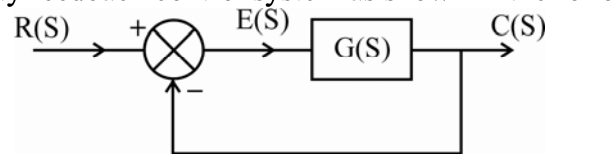
The steady state error is given as
To solve the problem of finding the steady state error for a given unity feedback control system, we need to understand a few concepts about steady state error in control systems.
The steady state error is a measure of the accuracy of a control system and determines how close the output of the system, \(C(S)\), is to the reference input, \(R(S)\), over time. For a unity feedback system, the forward path transfer function is denoted by \(G(S)\).
In general, the steady state error \(e_{\text{ss}}\) is given by:
\(e_{\text{ss}} = \lim_{s \to 0} \frac{R(S) - C(S)}{s}\)
For a unity feedback system, the transfer function of the closed-loop system is:
\(\frac{C(S)}{R(S)} = \frac{G(S)}{1 + G(S)}\)
Thus, the steady state error can be expressed as:
\(e_{\text{ss}} = \lim_{s \to 0} \frac{R(S) - \frac{G(S)}{1 + G(S)} \cdot R(S)}{s}\)
This simplifies to:
\(e_{\text{ss}} = \lim_{s \to 0} \frac{R(S) (1 - \frac{G(S)}{1 + G(S)})}{s}\)
Which further simplifies to:
\(e_{\text{ss}} = \lim_{s \to 0} \frac{R(S)}{1 + sG(S)}\)
Therefore, the correct option is:
\(\lim_{s \to 0} \frac{R(S)}{1 + s G(S)}\)
This is consistent with the concepts of evaluating steady state errors in a unity feedback control system. The formula is especially relevant for systems influenced by disturbances or imperfections in tracking the reference input over time.


