Consider a square sheet of side 1 unit. The sheet is first folded along the main diagonal. This is followed by a fold along its line of symmetry. The resulting folded shape is again folded along its line of symmetry. The area of each face of the final folded shape, in square units, equal to _____.
Square Sheet Folding: Step-by-Step Area Calculation
Let us analyze the folding process of the square sheet step by step to determine the area of each face of the final folded shape.
Initial Square Sheet
- The original sheet is a square with a side length of 1 unit.
- The initial area of the square is calculated as side × side.
- Area of the square \( = 1 \text{ unit} \times 1 \text{ unit} = 1 \text{ square unit}\).
First Fold: Along the Main Diagonal
- The square sheet is first folded along the main diagonal.
- When a square is folded along one of its main diagonals, it forms a double-layered isosceles right-angled triangle.
- The area of this visible triangular face is exactly half the area of the original square.
- Area after the first fold \( = \dfrac{1}{2} \times \text{Initial Area} = \dfrac{1}{2} \times 1 = \dfrac{1}{2} \text{ square unit}\).
- The resulting shape is an isosceles right-angled triangle.
Second Fold: Along its Line of Symmetry
- The current shape is the isosceles right-angled triangle from the previous step.
- An isosceles right-angled triangle has one line of symmetry, which is the altitude drawn from the right-angle vertex to the hypotenuse.
- Folding the triangle along this line of symmetry halves its visible area again.
- Area after the second fold \( = \dfrac{1}{2} \times \text{Area after first fold} = \dfrac{1}{2} \times \dfrac{1}{2} = \dfrac{1}{4} \text{ square unit}\).
- The resulting shape is a smaller isosceles right-angled triangle.
Third Fold: Along its Line of Symmetry
- The shape resulting from the second fold is again an isosceles right-angled triangle.
- This shape is then again folded along its line of symmetry, which is the altitude from its right-angle vertex to its hypotenuse.
- Similar to the previous step, this fold halves the visible area once more.
- Area after the third fold \( = \dfrac{1}{2} \times \text{Area after second fold} = \dfrac{1}{2} \times \dfrac{1}{4} = \dfrac{1}{8} \text{ square unit}\).
Final Folded Shape Area
After all three successive folds (one along the main diagonal and two along lines of symmetry), the final folded shape has an area that is one-eighth of the original square's area.
The area of each face of the final folded shape is \(\dfrac{1}{8}\) square units.
Important Questions from Paper Folding and Cutting
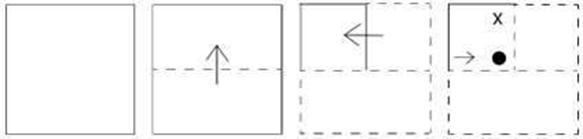
A square sheet of paper is folded along the dotted line successively along the directions shown and is then punched in the last. How would the paper look when unfolded?
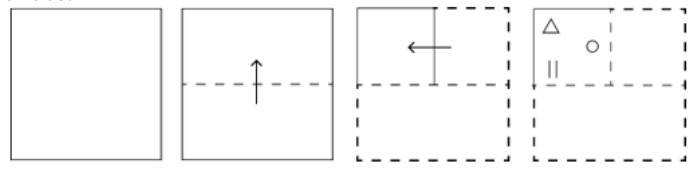
A square sheet of paper is folded along the dotted line successively along the directions shown and is then punched in the last. How would the paper look when unfolded?
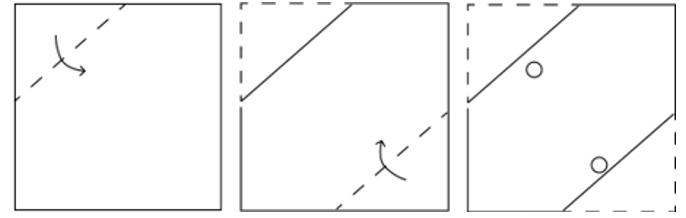
The sequence of folding a piece of paper and the manner in which the folded paper has been cut is shown below. Choose a figure which would most closely resemble the unfolded form of the paper.
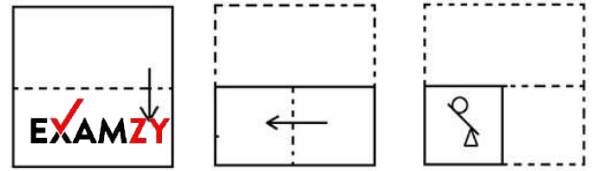
A paper is folded and cut as shown below. How will it appear when unfolded?
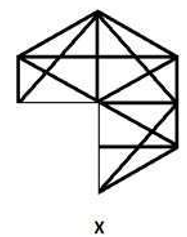
Select a figure from amongst the four given options which, when placed in the blank space of figure (X), would complete the pattern.