
Consider a function f(x, y, z) given by f(x, y, z) = (x2 + y2 – 2z2)(y2 + z2) The partial derivative of this function with respect to x at the point x = 2, y = 1 and z = 3 is _______
Concept:
In Partial Differentiation, all variables are considered as a constant except the independent derivative variable i.e If f(x,y,z) is a function, then its partial derivative with respect to x is calculated by keeping y and z as constant.
Calculation:
f(x, y, z) = (x2 + y2 – 2z2)(y2 + z2)
\(\frac{{\partial f}}{{\partial x}} = \left( {2x} \right)\left( {{y^2} + {z^2}} \right)\)
At the point, x = 2, y = 1 and z = 3 is
\(\frac{{\partial f}}{{\partial x}} = 2\left( 2 \right)\left( {{1^2} + {3^2}} \right) = 40\)
Important Questions from Differentiability
A differentiable function $f(x)$ is such that $f(-0.1) = 2, f(0) = 1, \text{ and } f(0.1) = 2$.
Then, $\frac{d^2f}{dx^2}$ at $x = 0$ is ______ (answer in integer).
- The differential of the equation, $x^2 + y^2 =1$, with respect to $x$ is
Suppose the function f(x) = x n, n ≠ 0 is differentiable for all x. Then n can be any element of the interval
The figure shows the distance vs time graph of a moving particle. The tangents to the curve at A and B make angles of $45^\circ$ and $60^\circ$ respectively with the time axis.
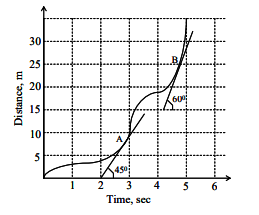
The ratio of the speeds of the particle at B and at A isDerivative of cos x with respect to x is


