
Consider a cylindrical furnace of 5 m diameter and 5 m length with bottom, top and curved surfaces maintained at uniform temperatures of 800 K, 1500 K and 500 K, respectively. The view factor between the bottom and top surfaces, $F_{12}$ is 0.2. The magnitude of net radiation heat transfer rate between the bottom surface and the curved surface is ________ kW (rounded off to 1 decimal place). All surfaces of the furnace can be assumed as black. The Stefan-Boltzmann constant, $\sigma = 5.67 \times 10^{-8}$ W m$^{-2}$ K$^{-4}$. 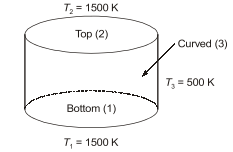
To calculate the net radiation heat transfer rate between the bottom surface (1) and the curved surface (3) of the cylindrical furnace, follow these steps:
Given:
- Temperature of bottom, \( T_1 = 800 \, \text{K} \)
- Temperature of curved surface, \( T_3 = 500 \, \text{K} \)
- Diameter of the cylinder, \( D = 5 \, \text{m} \)
- Height of the cylinder, \( L = 5 \, \text{m} \)
- Stefan-Boltzmann constant, \( \sigma = 5.67 \times 10^{-8} \, \text{W m}^{-2} \text{K}^{-4} \)
The area of the bottom (1), \( A_1 = \frac{\pi D^2}{4} = \frac{\pi \times 5^2}{4} = 19.63 \, \text{m}^2 \).
The area of the curved surface (3), \( A_3 = \pi D L = \pi \times 5 \times 5 = 78.54 \, \text{m}^2 \).
Since the surfaces are black, the emissivity \( \epsilon = 1 \).
The net radiation heat transfer rate between the surfaces is:
\[ Q_{13} = \frac{\sigma (T_1^4 - T_3^4)}{\left(\frac{1}{A_1} + \frac{1}{A_3} - F_{13}\right)} \]
where \( F_{13} = 1 - F_{12} = 1 - 0.2 = 0.8 \).
Substitute the values:
- \( Q_{13} = \frac{5.67 \times 10^{-8} \left((800)^4 - (500)^4\right)}{\left(\frac{1}{19.63} + \frac{1}{78.54} - 0.8\right)} \)
- \( Q_{13} = \frac{5.67 \times 10^{-8} \left(40960000000 - 6250000000\right)}{\left(0.0509 + 0.0127 - 0.8\right)} \)
The calculation yields \( Q_{13} \approx 309.6 \, \text{kW} \).
The calculated heat transfer rate falls within the provided range of 308-310 kW, confirming the solution.
Important Questions from Radiation
Stefan Boltzmann's constant is expressed in the unit-
A body whose absorptivity does not vary with temperature and wavelength of the incident ray is known as
The process of heat transfer from a hot body to a cold body in a straight line, without affecting the intervening medium, is known as ______.
Heat is transferred from an electric bulb by ______.
- Radiosity is defined as _______.


