
Consider a continuous-time signal x(t) defined by x(t) = 0 for |t| > 1, and x(t) = 1 - |t| for |t| ≤ 1. Let the Fourier transform of x(t) be defined as \(X(ω)=\displaystyle\int_{-\infty}^\infty x(t) e^{-jω t}dt\). The maximum magnitude of X(ω) is _____
Given,
x(t) = 0 for |t| > 1
x(t) = 1 - |t| for |t| ≤ 1
The waveform of function can be drawn as,
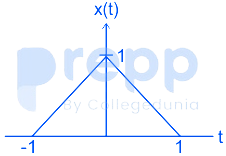
Hence, given function is triangular function,
\(x\left( t \right) = ATri\left( t \right)\)
From standered Fourier transform,
If \(x\left( t \right) = ATri\left( {\frac{t}{T}} \right)\)
Fourier transform of x(t) is given by
\(X\left( \omega \right) = ATs{a^2}\left( {\frac{{\omega T}}{2}} \right)\)
A = T = 1
\(X\left( \omega \right) = s{a^2}\left( {\frac{\omega }{2}} \right)\)
From the waveform of function,
\(X\left( \omega \right){\left. \right|_{peak}} = X\left( 0 \right) = s{a^2}\left( {\frac{0}{2}} \right) = 1\)
Therefore, the peak value of the sampling function occurs at (ω = 0).
The maximum magnitude (peak) of X(ω) will be 1.
Important Questions from Fourier Transform
- The FT of $x(t) = e^{4t} u(-t)$ is:
Fourier transform of the unit impulse δ(t) is
The function f(t) is a periodic function of period 2π. In the range (-π, π), it equals e-t. If f(t) = \(\sum\nolimits_{ - \infty }^\infty {{c_n}{e^{{\mathop{\rm int}} }}}\) denotes its Fourier series expansion, the sum \({\sum\nolimits_{ - \infty }^\infty {\left| {{c_n}} \right|} ^2}\) is
The function f(t) has a Fourier transform F(ω). The Fourier transform of F(t) is
Differentiating a signal in the time domain corresponds to _________ its FT in the frequency domain by _________.


