
Concept of inclusion requires
respect of diversity and individual differences
Inclusion in education means that all children, whatever their abilities, disabilities, gender, language, caste or socio-economic background, learn together in the same regular classroom. The school adapts its curriculum, pedagogy and assessment to the learner rather than expecting the learner to fit a fixed mould. NEP 2020 and the RTE Act 2009 frame this as equitable and inclusive education for every child.
The foundation of such a classroom is acceptance that learners differ from one another. A teacher who respects diversity and individual differences plans varied activities, uses multiple ways of representing ideas and allows different ways of showing learning, so that no child is excluded.
Standardised testing applies one uniform yardstick to every learner and ignores those differences. Teacher-centred pedagogy keeps the child passive and does not adjust to varied needs. Labelling and segregation of students is the direct opposite of inclusion, because it separates children into groups instead of bringing them together.
respect of diversity and individual differences option is correct.
Similar Questions
The value of the expression \((-3)^3 \times (0.3)^{-2} \times 0.01\) lies between which of the following ranges?
In a class test, a student earns 3 marks for every correct answer and loses 2 marks for every incorrect answer. No marks are given for questions left unattempted. If Radhika scored 20 marks and had 12 correct answers, how many questions did she attempt incorrectly?
If a polyhedron has 6 faces and 12 edges, what is the number of its vertices?
If \(a\) and \(b\) are positive integers (where \(b \neq 0\)) such that \(a^b = 1331\), then what is the value of \((a+b)^{a-b-8}\)?
Numbers that can be expressed as the sum of two cubes in two different ways are known as:
If \(x + \dfrac{y}{2} = \dfrac{1}{4}\), \(y + \dfrac{z}{2} = \dfrac{1}{4}\) and \(z + \dfrac{x}{2} = \dfrac{1}{4}\), then what is the value of \(x + y + z\)?
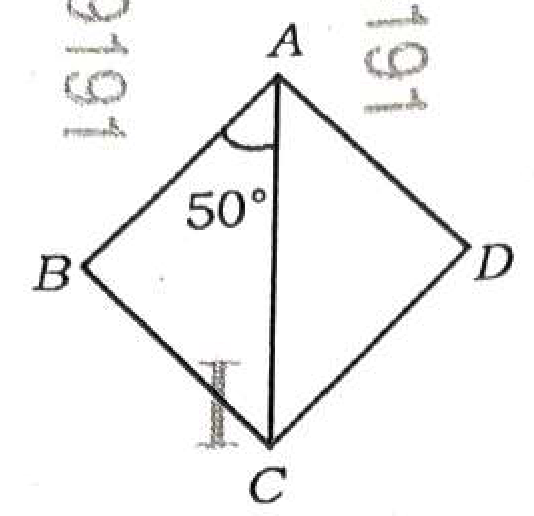
ABCD is a rhombus in which \(\angle BAC = 50^\circ\). What is the value of \(3\angle D - 2\angle DAC\)?
What is the value of \(\dfrac{\sqrt{450}}{\sqrt{338}} \div \dfrac{\sqrt{125}}{\sqrt{245}}\)?
The selling price of a toy is Rs. 1,020. If the profit made by the shopkeeper is 20%, what is the cost price of the toy?
The denominator of a rational number is greater than its numerator by 4. If 1 is added to both the numerator and the denominator, the resulting fraction is \(\dfrac{1}{2}\). Find the rational number.
Important Questions from Mixed Topic (JTET)
What type of process is thinking ?
The normal cause of origin of motivation is
How is impulse important for a teacher ?
The motive which forms due to social ideals, status, relations etc. is called
The learning in children starts from



