Choose the number which is different from others in the group.
1321
Finding the Different Number in the Group
The question asks us to identify the number that is different from the others in the given group of numbers: 27, 125, 343, and 1321.
To find the different number, we need to look for a pattern or property that applies to most of the numbers but not all of them. Let's examine each number:
- 27: This number can be obtained by cubing an integer. $27 = 3 \times 3 \times 3 = 3^3$. So, 27 is a perfect cube.
- 125: This number can also be obtained by cubing an integer. $125 = 5 \times 5 \times 5 = 5^3$. So, 125 is a perfect cube.
- 343: Let's check if this is a perfect cube. $343 = 7 \times 7 \times 7 = 7^3$. Yes, 343 is a perfect cube.
- 1321: Let's check if this number is a perfect cube. We know $10^3 = 1000$ and $11^3 = 1331$. Since 1321 is between 1000 and 1331, its cube root would be between 10 and 11, which is not an integer. Therefore, 1321 is not a perfect cube.
Based on this analysis, we can see a pattern: the numbers 27, 125, and 343 are all perfect cubes of integers (3, 5, and 7 respectively). The number 1321, however, is not a perfect cube.
Therefore, the number 1321 is different from the others in the group because it does not share the property of being a perfect cube.
Important Questions from Classification
Directions for the following 3 (three) items : consider the given information and answer the three items that follow.
A, B, C, D, E, F and G are Lecturers from different cities—Hyderabad, Delhi, Shillong, Kanpur, Chennai, Mumbai and Srinagar (not necessarily in the same order) who participated in a conference. Each one of them is specialized in a different subject, viz., Economics, Commerce, History, Sociology, Geography, Mathematics and Statistics (not necessarily in the same order).
Further 1. Lecturer from Kanpur is specialized in Geography
2. Lecturer D is from Shillong
3. Lecturer C from Delhi is specialized in Sociology
4. Lecturer B is specialized in neither History nor Mathematics
5. Lecturer A who is specialized in Economics does not belong to Hyderabad
6. Lecturer F who is specialized in Commerce belongs to Srinagar
7. Lecturer G who is specialized in Statistics belongs to Chennai
Who is specialized in Geography?
A, B, C, D, E, F and G are Lecturers from different cities—Hyderabad, Delhi, Shillong, Kanpur, Chennai, Mumbai and Srinagar (not necessarily in the same order) who participated in a conference. Each one of them is specialized in a different subject, viz., Economics, Commerce, History, Sociology, Geography, Mathematics and Statistics (not necessarily in the same order).
Further 1. Lecturer from Kanpur is specialized in Geography
2. Lecturer D is from Shillong
3. Lecturer C from Delhi is specialized in Sociology
4. Lecturer B is specialized in neither History nor Mathematics
5. Lecturer A who is specialized in Economics does not belong to Hyderabad
6. Lecturer F who is specialized in Commerce belongs to Srinagar
7. Lecturer G who is specialized in Statistics belongs to Chennai
To which city does the Lecturer specialized in Economics belong?
A, B, C, D, E, F and G are Lecturers from different cities—Hyderabad, Delhi, Shillong, Kanpur, Chennai, Mumbai and Srinagar (not necessarily in the same order) who participated in a conference. Each one of them is specialized in a different subject, viz., Economics, Commerce, History, Sociology, Geography, Mathematics and Statistics (not necessarily in the same order).
Further 1. Lecturer from Kanpur is specialized in Geography
2. Lecturer D is from Shillong
3. Lecturer C from Delhi is specialized in Sociology
4. Lecturer B is specialized in neither History nor Mathematics
5. Lecturer A who is specialized in Economics does not belong to Hyderabad
6. Lecturer F who is specialized in Commerce belongs to Srinagar
7. Lecturer G who is specialized in Statistics belongs to Chennai
Who of the following belongs to Hyderabad?
In a school, there are five teachers A, B, C, D and E. A and B teach Hindi and English. C and B teach English and Geography. D and A teach Mathematics and Hindi. E and B teach History and French. Who teaches maximum numb, of subjects?
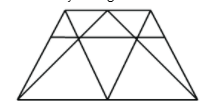
How many triangles are there in the given figure?