
Body A having a mass of 2 kg and body B having a mass of 3 kg moving towards each other with velocities 4 m/s and 2 m/s, respectively, will collide and ______ in an elastic collision.
move in opposite direction
Concept:
Collisions are generally classified into two types: elastic and inelastic collisions.
This classification is based on the law of conservation, and the laws of collision state:
- Momentum is conserved in all collisions.
- Kinetic energy is also conserved in elastic collisions.
- In an inelastic collision, kinetic energy is not conserved. In a perfectly inelastic collision, the objects stick together after the collision.
Perfectly elastic collision
If the laws of momentum conservation and kinetic energy hold well during the collision.
That is, initial velocity = final velocity
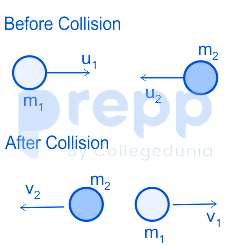
Inelastic collision
If the law of momentum conservation holds well during the collision while kinetic energy does not.
However, inelastic collisions follow the law of conservation of linear momentum.
Coefficient of restitution (e)
\(e = \frac{{Relative\;velocity\;after\;collision}}{{Relative\;velocity\;before\;collision}} = \frac{{{v_2} - {v_1}}}{{{u_1} - {u_2}}}\)
- For a perfectly elastic collision, e = 1
- For an inelastic collision, e <1
- For a perfectly inelastic collision, e = 0
Calculation:
Let us assume that,
Mass of body A, mA = 2 kg
Block A, uA = 4 m/s . velocity
Mass of body B, mB = 3 kg
Velocity of block B, uB = -2 m/s
Now, according to the law of conservation of momentum
mA uA + mB uB = mA vA + mB vB
2 x 4 - 3 x (-2) = 2 x vA + 3 x vB
2 x vA + 3 x vB = 2 -----(1)
Now, for an inelastic collision, the coefficient of restitution is always one and can be expressed as
\(e=1=\frac{{{v}_{B}}-{{v}_{A}}}{{{u}_{A}}-{{u}_{B}}}=\frac{{{v}_{B}}-{{v}_{A}}}{4+2}\Rightarrow {{v}_{B}}-{{v}_{A}}=6\) ------(2)
Thus, comparing both quadratic equations, we obtain the values of the velocities of bodies A and B as follows
\({{v}_{B}}=\frac{14}{5}m/s\)
And now substituting this value into eq (2), we get, \({{v}_{A}}=-\frac{16}{5}m/s\)
Thus, we can see that body A will be moving in the opposite direction compared to body B.
Therefore, in this case, body A and body B will move in opposite directions in an elastic collision.
Important Questions from Motion
Due to an acceleration of 2 m/s 2, the velocity of a body increases from 20 m/s to 30 m/s in a certain period. Find the displacement (in m) of the body in that period.
An object is covering distance in direct proportion to the square of time elapsed. What conclusion can be drawn about the motion of the object?
If the distance time graph of the motion of an object is a straight line but not parallel to the time axis, then it may be concluded that the object is moving with a:
Which of the following changes when a body performs uniform circular motion?
Vehicles have treaded tires so that it_______.


