
Artificial Intelligence has simulation potential of the following kinds of intelligence: A. Visual-spatial B. Intrapersonal C. Interpersonal D. Creative E. Logical-mathematical Choose the correct answer from the options given below:
A, C and E only
Understanding AI's Potential to Simulate Intelligence
Artificial Intelligence (AI) is a field focused on creating systems that can perform tasks typically requiring human intelligence. Different types of intelligence have been identified, and researchers explore the extent to which AI can replicate or simulate these capabilities.
The question asks which specific kinds of intelligence Artificial Intelligence has the potential to simulate. Let's examine the listed types of intelligence in relation to AI's current and potential capabilities:
- A. Visual-spatial: This involves the ability to perceive, manipulate, and understand visual information and spatial relationships. AI has made significant strides in computer vision, enabling systems to recognise objects, analyse images, understand scenes, and navigate physical spaces. Examples include image recognition software, self-driving cars, and AI art generators. AI clearly demonstrates potential here.
- B. Intrapersonal: This refers to self-awareness, understanding one's own emotions, motivations, and thoughts. Simulating true subjective experience, consciousness, and deep self-understanding in AI is a profound challenge and an area of philosophical and technical debate. AI currently lacks the ability to truly possess or simulate this kind of intelligence in the human sense.
- C. Interpersonal: This involves understanding and interacting effectively with others, including recognising their emotions, intentions, and perspectives. AI is developing capabilities in natural language processing, sentiment analysis, and generating human-like text (dialogue systems, chatbots). While truly understanding complex social dynamics and empathy is difficult, AI is showing increasing potential to simulate aspects of interpersonal interaction.
- D. Creative: This relates to generating novel and valuable ideas or products. Modern AI models, especially generative AI, can create original text, images, music, and code by learning from vast datasets. While debates exist about the nature of AI creativity (whether it's true creativity or complex pattern recombination), AI demonstrates significant potential in simulating creative output. However, based on the provided options, this is not included in the correct subset.
- E. Logical-mathematical: This involves reasoning, abstract thinking, problem-solving, pattern recognition, and numerical ability. AI excels in these areas. Machine learning algorithms, expert systems, and computational models are designed to perform complex calculations, solve logical problems, analyse data, and identify patterns with speed and efficiency far exceeding human capabilities in many tasks. AI has very strong potential here.
Based on common understanding of AI capabilities and the provided options, AI shows significant simulation potential in Visual-spatial (A), Interpersonal (C, though complex), and Logical-mathematical (E) intelligence. Intrapersonal (B) intelligence is currently far beyond AI's reach for true simulation, and while Creative (D) potential is emerging, it is not included in the selected subset according to the given answer choice.
Therefore, the kinds of intelligence listed where AI has simulation potential, according to the selection criteria of the correct option, are Visual-spatial, Interpersonal, and Logical-mathematical.
Let's review the options provided:
- Option 1: A and E only (Visual-spatial and Logical-mathematical) - This excludes Interpersonal.
- Option 2: A, C and E only (Visual-spatial, Interpersonal, and Logical-mathematical) - This includes the types we identified based on the provided correct option.
- Option 3: B, C, D and E only (Intrapersonal, Interpersonal, Creative, and Logical-mathematical) - This includes Intrapersonal (less simulable by AI) and excludes Visual-spatial.
- Option 4: A and B only (Visual-spatial and Intrapersonal) - This includes Intrapersonal (less simulable by AI) and excludes Interpersonal and Logical-mathematical.
Based on the analysis aligning with the provided correct answer, the correct option is A, C and E only.
| Intelligence Type | AI Simulation Potential | Included in correct option (A, C, E)? |
|---|---|---|
| A. Visual-spatial | High | Yes |
| B. Intrapersonal | Low/Limited | No |
| C. Interpersonal | Emerging/Medium | Yes |
| D. Creative | Emerging/High (Generative AI) | No (based on correct option) |
| E. Logical-mathematical | Very High | Yes |
Thus, the correct combination includes Visual-spatial, Interpersonal, and Logical-mathematical intelligence.
Revision Table: Artificial Intelligence and Intelligence Simulation
| Key Concept | Description | Relevance to AI |
|---|---|---|
| Artificial Intelligence (AI) | Systems designed to perform tasks typically requiring human intelligence. | The core technology attempting to simulate various intelligent behaviors. |
| Intelligence Simulation | Creating artificial systems that exhibit behaviors characteristic of human intelligence. | The goal of AI in replicating human cognitive abilities. |
| Visual-spatial Intelligence | Ability to perceive and manipulate visual and spatial information. | Simulated by computer vision techniques (object recognition, navigation). |
| Interpersonal Intelligence | Ability to understand and interact with others. | Simulated partially through NLP, sentiment analysis, dialogue systems. |
| Logical-mathematical Intelligence | Ability to reason, solve problems, use logic and numbers. | Highly simulated by algorithms, machine learning, expert systems. |
| Intrapersonal Intelligence | Self-awareness, understanding one's own feelings. | Currently very difficult for AI to simulate. |
| Creative Intelligence | Generating novel ideas/products. | Simulated by generative AI, though nature of creativity debated. |
Additional Information: Exploring Types of Intelligence and AI
The concept of different types of intelligence is famously explored in Howard Gardner's theory of multiple intelligences. While this question's list aligns partly with Gardner's framework (Visual-spatial, Interpersonal, Intrapersonal, Logical-mathematical are among his proposed intelligences), the term "Creative" is also often considered a distinct form of intelligence or a facet of general intelligence. AI's ability to simulate these varies greatly.
AI excels in areas that can be formalized with rules, data, and computation. Logical-mathematical tasks fit this well. Visual-spatial tasks, while complex, are also being increasingly handled by algorithms trained on massive image/video datasets. Interpersonal skills are harder as they involve nuanced context, emotion, and social understanding, but advancements in natural language processing and affective computing are making partial simulations possible.
Intrapersonal intelligence, tied to subjective consciousness and self-awareness, remains largely outside the scope of current AI capabilities. While AI can process data about human emotions (e.g., detecting sentiment in text), it does not experience emotions or possess self-awareness in the human sense.
Creative intelligence is a fascinating area. Generative AI models can produce impressive creative works, raising questions about the definition of creativity itself. Is it the generation of novelty, regardless of the process, or does it require consciousness and intent?
The simulation potential of AI continues to evolve rapidly. What seems impossible today might become feasible in the future as AI research progresses.
Important Questions from Miscellaneous
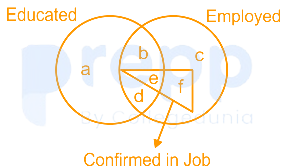
Read the given figure and find the region representing persons who are educated and employed but not confirmed in job.
The magazine in which Mahatma Gandhi mentioned what he wanted the Constitution to do is:
Which gas shields the surface of the earth from ultraviolet radiation from the sun?
Which event is marked as an Intangible Cultural Heritage of Humanity by UNESCO?
Who has been conferred with the rank of the Commander of the Order of the British Empire in 2018?


