
Arrange the following types of intelligence which a computer can simulate in the ascending order: A. Visual-spatial B. Logical mathematical C. Linguistic D. Interpersonal E. Bodily kinesthetic Choose the correct answer from the options given below
C, D, A, E, B
Understanding Computer Intelligence Simulation Difficulty
The question asks us to arrange different types of intelligence based on how easily current computers or Artificial Intelligence (AI) systems can simulate them. We need to place them in ascending order, meaning from the easiest to simulate to the most difficult to simulate.
Let's consider the types of intelligence listed:
- A. Visual-spatial: Involves recognizing patterns in space, manipulating objects, and understanding visual information.
- B. Logical mathematical: Deals with logical reasoning, calculations, problem-solving, and recognizing abstract patterns.
- C. Linguistic: Pertains to language, including reading, writing, understanding, and speaking.
- D. Interpersonal: Relates to understanding and interacting effectively with others, including sensing moods, feelings, and motivations.
- E. Bodily kinesthetic: Involves using one's body effectively, coordinating physical movements, and manipulating objects physically.
Based on the provided correct answer, the ascending order of difficulty for computer simulation is considered to be C, D, A, E, B.
Let's examine why this specific order might be considered, moving from what is potentially considered easier for current AI to simulate towards what is considered more difficult, following the provided sequence:
- Linguistic (C): Current AI has made significant progress in processing and generating human language (Natural Language Processing - NLP). While deep understanding is still a challenge, tasks like text analysis, translation, and basic conversation simulation are relatively well-developed areas, potentially placing it among the easier types to simulate at a basic level.
- Interpersonal (D): Simulating interpersonal intelligence is complex. However, AI can be designed to recognize sentiment in text, follow conversation flows, and even simulate basic social interactions in controlled environments (like chatbots). While simulating true empathy or nuanced social understanding is very difficult, perhaps basic interpersonal simulation is considered the next step up from purely linguistic processing.
- Visual-spatial (A): Computer vision has advanced greatly, allowing AI to recognize objects, navigate spaces, and process images. However, interpreting complex visual scenes, understanding 3D relationships, and manipulating virtual or real objects based on visual input involves sophisticated processing and integration, potentially making it harder than basic linguistic or interpersonal simulation.
- Bodily kinesthetic (E): This involves physical action in the real world. While robotics allows computers to perform physical tasks, simulating the learning, adaptation, and fine motor control of human bodily kinesthetic intelligence is highly challenging. Dealing with the complexities of physics, real-time sensory feedback, and unpredictable environments makes this significantly difficult.
- Logical mathematical (B): This might seem counter-intuitive as computers are built on logic and excel at calculations. However, simulating the *human process* of logical-mathematical intelligence – including intuition, creative problem-solving, and handling abstract concepts that don't map directly to concrete data or rules – could be considered the most challenging aspect for AI to fully replicate, especially tasks requiring abstract reasoning beyond predefined algorithms. Simulating human ingenuity in mathematics or complex, unstructured logical deduction could be viewed as the pinnacle of AI simulation difficulty.
Following the provided order, we arrange the intelligence types from C (Linguistic) as the easiest to simulate to B (Logical mathematical) as the most difficult to simulate in a comprehensive, human-like manner.
| Rank | Intelligence Type | Abbreviation | Potential Rationale for Placement (Following Provided Order) |
|---|---|---|---|
| 1 (Easiest) | Linguistic | C | Basic language processing is relatively mature in AI. |
| 2 | Interpersonal | D | Simulating basic interaction and sentiment is achievable after linguistic processing. |
| 3 | Visual-spatial | A | Processing complex visual data is harder than basic text or dialogue. |
| 4 | Bodily kinesthetic | E | Requires complex physical interaction, control, and adaptation in the real world. |
| 5 (Hardest) | Logical mathematical | B | Simulating human-like abstract reasoning and creative problem-solving in mathematics is a significant challenge. |
Thus, the ascending order of intelligence types by computer simulation difficulty, based on the provided answer, is C, D, A, E, B.
Revision Table - Computer Intelligence Simulation
| Intelligence Type | AI Field | Simulation Progress | Challenges |
|---|---|---|---|
| Linguistic | Natural Language Processing (NLP) | Significant progress in processing, translation, generation. | Deep understanding, context, nuance, creativity. |
| Logical mathematical | Symbolic AI, Machine Learning | Excellent at calculation, pattern finding, rule application. | Human-like intuition, creativity, handling ill-defined problems. |
| Visual-spatial | Computer Vision | Good at object recognition, navigation, image analysis. | Complex scene understanding, dynamic environments, subjective interpretation. |
| Interpersonal | Affective Computing, Dialogue Systems | Basic sentiment analysis, simple conversational flow. | Empathy, social cues, understanding complex human emotions, building relationships. |
| Bodily kinesthetic | Robotics, Reinforcement Learning | Performing pre-programmed tasks, learning specific physical skills. | General dexterity, adaptation to novel physical tasks, real-time learning, handling unpredictable physical environments. |
Additional Information - AI and Types of Intelligence
The ability of computers to simulate different aspects of human intelligence is a core area of Artificial Intelligence research. While computers often surpass humans in tasks requiring speed, data processing, or complex calculations (aligned with logical-mathematical skills), simulating the full spectrum of human intelligence, especially those involving social interaction, physical dexterity, or intuitive reasoning, remains a significant challenge.
Different types of intelligence present unique hurdles for AI development:
- Linguistic Intelligence: Requires AI to understand semantics, syntax, pragmatics, and context in language. While rule-based systems and statistical models have been effective, achieving true understanding and fluent, contextually appropriate generation is complex.
- Logical Mathematical Intelligence: Computers naturally handle logic and math. The difficulty lies in simulating the creative, insightful, and intuitive aspects of human mathematical thought, which goes beyond just computation.
- Visual-Spatial Intelligence: Involves interpreting unstructured visual data, understanding spatial relationships, and performing tasks in 3D space. This requires sophisticated algorithms for image processing, feature extraction, and geometric reasoning.
- Interpersonal Intelligence: This is highly challenging as it involves understanding human emotions, intentions, social norms, and complex communication cues (verbal and non-verbal). Simulating empathy or building genuine rapport is currently beyond AI capabilities.
- Bodily Kinesthetic Intelligence: Requires AI systems (robots) to interact physically with the environment. This involves complex control systems, sensory integration (like touch and proprioception), planning movements, and adapting to unforeseen physical circumstances.
The order of difficulty can be debated and changes as AI technology advances. Areas like logical-mathematical calculation are where computers are strongest, while simulating nuanced human interaction (interpersonal) or highly adaptable physical skills (bodily kinesthetic) are generally considered among the most difficult challenges for AI.
Important Questions from Miscellaneous
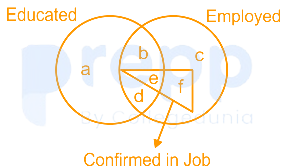
Read the given figure and find the region representing persons who are educated and employed but not confirmed in job.
The magazine in which Mahatma Gandhi mentioned what he wanted the Constitution to do is:
Which gas shields the surface of the earth from ultraviolet radiation from the sun?
Which event is marked as an Intangible Cultural Heritage of Humanity by UNESCO?
Who has been conferred with the rank of the Commander of the Order of the British Empire in 2018?


