An empty plastic mug floats in a bucket of water. When a solid iron ball is kept in the mug it doesn't sink. When the ball is put in the water it sinks. Compared to when the ball is in water, the water level in the bucket when the ball is in the mug is
Buoyancy Principles Explained
This problem involves understanding the concepts of buoyancy and Archimedes' principle. Buoyancy is the upward force exerted by a fluid that opposes the weight of an immersed object. Archimedes' principle states that the buoyant force on an object submerged in a fluid is equal to the weight of the fluid displaced by the object.
The water level in a container rises based on the volume of water displaced by objects placed in it. We need to compare the total volume of displaced water in two scenarios:
- Scenario 1: An iron ball is placed inside a plastic mug, and the mug floats.
- Scenario 2: The iron ball is removed from the mug and placed directly into the water, where it sinks.
Scenario 1: Floating Mug with Ball
When the empty plastic mug floats, it displaces a volume of water equal in weight to the mug itself. When the solid iron ball is placed inside the mug, the mug still floats. This means the combined weight of the mug and the ball is supported by the buoyant force.
Let $W_{mug}$ be the weight of the mug and $W_{ball}$ be the weight of the iron ball.
According to Archimedes' principle, the total weight of the water displaced ($W_{disp1}$) is equal to the total weight of the floating object (mug + ball):
$ W_{disp1} = W_{mug} + W_{ball} $
The volume of water displaced, $V_{disp1}$, is related to this weight by:
$ V_{disp1} = \frac{W_{disp1}}{\rho_{water} \times g} = \frac{W_{mug} + W_{ball}}{\rho_{water} \times g} $
where $\rho_{water}$ is the density of water and $g$ is the acceleration due to gravity.
Scenario 2: Sinking Ball in Water
In this scenario, the plastic mug floats alone, displacing water equal to its own weight ($W_{mug}$).
The solid iron ball is now placed in the water and sinks. An object sinks if its density is greater than the density of the fluid. Since it's an iron ball, its density ($\rho_{ball}$) is significantly greater than the density of water ($\rho_{water}$).
When the ball sinks, it displaces a volume of water equal to its own volume ($V_{ball}$). The weight of this displaced water is $W_{disp\_ball} = V_{ball} \times \rho_{water} \times g$. Because the ball sinks, its weight ($W_{ball}$) is greater than this buoyant force.
The total volume of water displaced in this scenario ($V_{disp2}$) is the sum of the volume displaced by the floating mug and the volume displaced by the submerged ball:
$ V_{disp2} = V_{mug\_disp} + V_{ball} $
The volume displaced by the floating mug ($V_{mug\_disp}$) is:
$ V_{mug\_disp} = \frac{W_{mug}}{\rho_{water} \times g} $
So, the total displaced volume is:
$ V_{disp2} = \frac{W_{mug}}{\rho_{water} \times g} + V_{ball} $
Water Level Comparison: Displaced Volumes
To compare the water levels, we need to compare the total volumes of displaced water, $V_{disp1}$ and $V_{disp2}$.
- $V_{disp1} = \frac{W_{mug} + W_{ball}}{\rho_{water} \times g}$
- $V_{disp2} = \frac{W_{mug}}{\rho_{water} \times g} + V_{ball}$
Let's analyze the difference between these volumes:
$ V_{disp1} - V_{disp2} = \left( \frac{W_{mug} + W_{ball}}{\rho_{water} \times g} \right) - \left( \frac{W_{mug}}{\rho_{water} \times g} + V_{ball} \right) $
Simplifying this gives:
$ V_{disp1} - V_{disp2} = \frac{W_{ball}}{\rho_{water} \times g} - V_{ball} $
We know that the weight of the ball is $W_{ball} = m_{ball} \times g = (\rho_{ball} \times V_{ball}) \times g$. Substituting this:
$ V_{disp1} - V_{disp2} = \frac{\rho_{ball} \times V_{ball} \times g}{\rho_{water} \times g} - V_{ball} $
$ V_{disp1} - V_{disp2} = \left( \frac{\rho_{ball}}{\rho_{water}} - 1 \right) V_{ball} $
Since the ball is made of iron, its density ($\rho_{ball}$) is greater than the density of water ($\rho_{water}$). This means the ratio $\frac{\rho_{ball}}{\rho_{water}}$ is greater than 1.
- Consequently, the term $\left( \frac{\rho_{ball}}{\rho_{water}} - 1 \right)$ is positive.
- As the ball's volume ($V_{ball}$) is also positive, the entire difference $V_{disp1} - V_{disp2}$ must be positive.
Therefore, $V_{disp1} > V_{disp2}$.
A greater displaced volume leads to a higher water level. This means the water level is higher when the iron ball is inside the floating mug compared to when the ball sinks in the water.
Final Conclusion on Water Level
The water level in the bucket is higher when the ball is in the mug.
Important Questions from Miscellaneous
Unemployment that arises when people are between jobs is known as:
PET is a very familiar form of ___________. It is used for making bottles.
India's population growth is characterized by
- Which of the following is true?
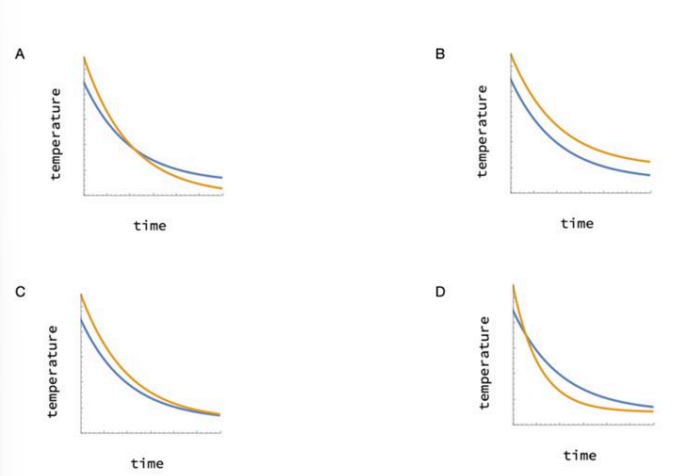
Two identical metal bars are heated to different temperatures and allowed to cool in the same surroundings. Which one of the following figures correctly shows their cooling curves?