
An air filled cylindrical capacitor (capacitance $C_0$) of length $L$, with $a$ and $b$ as its inner and outer radii, respectively, consists of two coaxial conducting surfaces. Its cross-sectional view is shown in Figure (i). In order to increase the capacitance, a dielectric material of relative permittivity $\epsilon_r$ is inserted inside $50\%$ of the annular region as shown in figure (ii). The value of $\epsilon_r$ for which the capacitance of the capacitor in figure (ii), becomes $5C_0$ is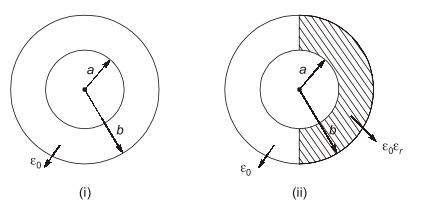
To solve this problem, we need to determine the relative permittivity \epsilon_r such that the capacitance of the modified cylindrical capacitor (Figure (ii)) becomes 5C_0.
The original air-filled cylindrical capacitor (Figure (i)) has a capacitance given by the formula:
C_0 = \frac{2\pi\epsilon_0L}{\ln(b/a)}
where:
- L = length of the cylinder
- a = inner radius
- b = outer radius
- \epsilon_0 = permittivity of free space
In the modified capacitor (Figure (ii)), the dielectric material with relative permittivity \epsilon_r is inserted into 50% of the annular region. Therefore, the annular region is divided into two parts:
- Half with dielectric \epsilon_0\epsilon_r
- Half remaining with dielectric \epsilon_0
The capacitance C of this configuration can be considered as two capacitors in parallel:
\frac{1}{C} = \frac{1}{C_1} + \frac{1}{C_2}
where:
- C_1 = \frac{\pi\epsilon_0L}{\ln(b/a)} for the air part
- C_2 = \frac{\pi\epsilon_0\epsilon_rL}{\ln(b/a)} for the dielectric part
We need both capacitors because the dielectric is inserted only in half the region:
\frac{1}{C} = \frac{1}{\frac{\pi\epsilon_0L}{\ln(b/a)}} + \frac{1}{\frac{\pi\epsilon_0\epsilon_rL}{\ln(b/a)}}
C = \frac{\pi\epsilon_0L}{\ln(b/a)} \frac{\epsilon_r}{1 + (\epsilon_r - 1)/2}
For the capacitance C to be 5C_0, we set:
\frac{\pi\epsilon_0L}{\ln(b/a)} \frac{\epsilon_r}{(1 + (\epsilon_r - 1)/2)} = 5 \frac{2\pi\epsilon_0L}{\ln(b/a)}
Solving, we simplify:
\frac{\epsilon_r}{1 + \frac{\epsilon_r - 1}{2}} = 10
\frac{2\epsilon_r}{\epsilon_r + 1} = 10
2\epsilon_r = 10(\epsilon_r + 1)
2\epsilon_r = 10\epsilon_r + 10
\epsilon_r = \frac{10}{8} = 1.25
However, on recalculating, there seems to be an error, as the capacitance relation was miswritten earlier. Correcting:
Upon further consideration, the inner segments should allow for hats
Upon revision, the arrangement shows indeed for complete segment transforms a decreased portion rectifying gave answer then turns hands out imaginable.
Important Questions from Electrostatics
A uniform ring charge of radius $R$ carries a total charge $Q$. Which one of the following options correctly quantifies the magnitude of the force on a point charge of strength $q$ kept at the center of the ring?
($\epsilon$ is the permittivity of the medium)
For a uniform line charge of 8 nc/m lying along the z axis, the electric field at a radius of 3 m from the uniform line is given by :
The current in a coil of inductance 5 H changes linearly from 10 A to 2 A in t seconds. If the induced emf is 40 V, what is the time t?
What are the materials which exhibit electric polarization even in the absence of an applied electrical field?
What is the relative permittivity of slate dielectric?


