
_____ addressing mode is most suitable to change the normal sequence of execution of instructions.
Relative
Understanding Instruction Execution Sequence and Addressing Modes
Computers execute instructions one after another in a sequence. This sequence is usually linear, meaning after one instruction finishes, the processor moves to the next instruction in memory. However, programs often need to change this normal flow. This is where control flow instructions like jumps and branches come in. Addressing modes determine how the operand (the data or the address of the data) for an instruction is found.
Changing the Normal Execution Flow
The normal sequence of instruction execution can be changed by instructions that modify the Program Counter (PC). The PC is a register that holds the memory address of the next instruction to be executed. When the PC's value is changed to point to a different location, the execution sequence "jumps" or "branches" to that new location.
Different addressing modes can be used with instructions, but some are more suitable than others for implementing these sequence-changing operations.
Analyzing Addressing Modes for Sequence Control
Let's look at the given addressing modes and how they relate to changing the instruction execution sequence:
- Index Addressing: In this mode, the effective address is calculated by adding an index value (often in an index register) to a base address. This mode is primarily used for accessing elements within data structures like arrays. It is not directly used for specifying the target address of a jump or branch instruction to change the program flow itself, although the data being accessed might influence a conditional branch.
- Relative Addressing: In relative addressing, the effective address is calculated relative to the address of the current instruction (or the next instruction). Typically, an offset is added to the Program Counter (PC). For example, a jump instruction might specify an offset of +100 bytes or -50 bytes from the current PC. This mode is extremely common for implementing branch and jump instructions, especially for position-independent code or within loops and conditional blocks, because the target address is specified relative to the current location, making the code relocatable. The calculation often looks like: $$ \text{Effective Address} = \text{Program Counter} + \text{Offset} $$
- Immediate Addressing: In this mode, the actual data (operand) is part of the instruction itself. This is used for loading constants or small values directly. It does not specify an address for changing the execution sequence.
- Indirect Addressing: In indirect addressing, the address field of the instruction contains the address of a memory location, and that memory location contains the effective address of the operand. While indirect addressing *can* be used to implement jump tables (which change sequence), relative addressing is the most common and direct method for typical branch and jump instructions used to alter the sequential flow based on conditions or for unconditional jumps.
Why Relative Addressing is Most Suitable
Relative addressing is most suitable for changing the normal sequence of execution because jump and branch instructions are fundamentally about moving to a different point in the code stream relative to the current position. Using an offset relative to the PC allows the target address to be specified compactly and makes the code position-independent (it can be loaded anywhere in memory and still work correctly, as branches just move a certain distance relative to the current PC). Most modern processor architectures heavily rely on PC-relative addressing for control flow instructions.
| Addressing Mode | Primary Use | Suitable for Changing Execution Sequence? | Reason |
|---|---|---|---|
| Index | Array/structure access | Less suitable directly | Used for data access, not typically jump targets |
| Relative | Branch/Jump targets | Most Suitable | Directly calculates target relative to PC; ideal for control flow |
| Immediate | Loading constants | No | Operand is data, not an address for flow change |
| Indirect | Pointers, jump tables (less common for simple branches) | Possible, but Relative is more direct for typical branches | Requires fetching the address from memory |
Conclusion
Based on the analysis, Relative addressing mode is the most suitable addressing mode specifically designed and most commonly used to implement instructions that change the normal sequence of execution, such as jumps and branches, by specifying the target address relative to the current instruction's location (via the Program Counter).
Revision Table: Relative Addressing
| Concept | Description |
|---|---|
| Definition | Effective address calculated by adding an offset to the Program Counter (PC). |
| Calculation Example | Target Address = PC + Offset |
| Primary Application | Jump and Branch instructions (control flow). |
| Key Benefit | Code is often position-independent (relocatable). |
| Offset Value | Can be positive (jump forward) or negative (jump backward). |
Additional Information: Other Addressing Modes
While relative addressing is key for sequence changes, understanding other modes is crucial for overall processor architecture:
- Direct Addressing: The instruction contains the exact memory address of the operand. Simple but not flexible.
- Register Addressing: The operand is located in a CPU register specified in the instruction. Very fast access.
- Register Indirect Addressing: The instruction specifies a register that contains the memory address of the operand. Useful for pointers.
- Base Register Addressing: Similar to Index addressing, but one register holds a base address and an offset is added. Often used for accessing fields in records or structures.
Each addressing mode serves a specific purpose in accessing data or determining the next instruction, contributing to the overall flexibility and efficiency of a computer's instruction set architecture.
Important Questions from Miscellaneous
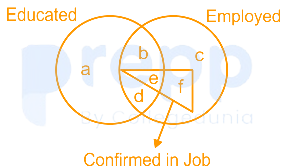
Read the given figure and find the region representing persons who are educated and employed but not confirmed in job.
The magazine in which Mahatma Gandhi mentioned what he wanted the Constitution to do is:
Which gas shields the surface of the earth from ultraviolet radiation from the sun?
Which event is marked as an Intangible Cultural Heritage of Humanity by UNESCO?
Who has been conferred with the rank of the Commander of the Order of the British Empire in 2018?


