
According to Max Weber, which entities are always struggling for domination?
Understanding Max Weber's Dimensions of Struggle for Domination
Max Weber, a foundational sociologist, provided a multidimensional view of social stratification and power. Unlike Karl Marx, who focused primarily on economic class, Weber argued that society is stratified along three main dimensions: class, status, and party. Each of these dimensions involves different forms of power, conflict, and struggle for domination.
Analyzing the Concepts in Weber's Framework
Let's look at the entities mentioned in the options according to Weber's theories:
- Class: According to Weber, a class is a group of people who share a similar economic situation based on their position in the market (e.g., owners of capital, skilled workers, unskilled workers). Class situation relates to market opportunities and life chances. Struggle in the class dimension is primarily economic, revolving around the distribution of resources, wealth, and opportunities. Weber acknowledged that this economic struggle is a significant and persistent source of conflict.
- Status: Status groups are based on social honor, prestige, and lifestyle. Membership is often determined by social estimation and patterns of consumption rather than purely economic factors. Status groups engage in struggle to maintain or enhance their social standing, often through processes of social closure (excluding others). This is a struggle for social recognition and honor, which can translate into various forms of influence.
- Party: Parties, in Weber's terms, are associations aimed at securing power within an organization or the state to achieve specific goals or interests. Parties operate in the political realm and are explicitly organized for the struggle for political power and domination.
- Class situation: This refers to an individual's specific position within the class structure based on their market situation. While it determines one's life chances and potential for conflict, it is a structural position rather than an active entity that struggles.
Identifying the Entity Always Struggling for Domination
The question asks which entity is *always* struggling for domination according to Weber. While all three dimensions (class, status, party) involve struggle and forms of power or influence, the nature and sphere of this struggle differ.
- Parties are explicitly about the struggle for political power (domination in the political sphere).
- Status groups struggle for social honor and influence (social domination).
- Class, based on economic position, is the site of struggle over resources, wealth, and market opportunities. This economic struggle is fundamental and persistent, influencing one's fundamental life chances and power in the economic realm, which often underpins or translates into other forms of power and domination.
Considering the options and Weber's emphasis on economic struggle as a continuous element influencing social structure and power dynamics, the struggle associated with 'Class' over resources and market position can be seen as a foundational and persistent form of struggle for economic power and influence, which is a key component of overall domination.
Conclusion
Based on Max Weber's analysis of social stratification and conflict, while struggle occurs across class, status, and party lines, the fundamental and continuous struggle related to economic position and the distribution of resources is centered around Class. This economic struggle is a constant factor influencing social relations and the potential for various forms of domination.
Therefore, according to Max Weber, entities defined by their Class are always struggling for domination in the economic sphere, which forms a crucial basis for power and influence in society.
Revision Table: Max Weber's Stratification Dimensions
| Dimension | Basis | Type of Struggle/Power | Sphere |
|---|---|---|---|
| Class | Economic position, market situation | Economic power, struggle over resources and life chances | Economic |
| Status | Social honor, prestige, lifestyle | Social honor, influence, social closure | Social |
| Party | Political power, goals | Political power, struggle for control of organizations/state | Political |
Additional Information on Weber and Domination
Max Weber extensively studied the concept of domination (Herrschaft), which he defined as the probability that commands will be obeyed by a given group of persons. He identified three pure types of legitimate domination:
- Rational-Legal Domination: Based on belief in the legality of enacted rules and the right of those elevated to authority under such rules to issue commands (e.g., bureaucracy).
- Traditional Domination: Based on an established belief in the sanctity of immemorial traditions and the legitimacy of the status of those exercising authority under them (e.g., monarchy).
- Charismatic Domination: Based on devotion to the exceptional sanctity, heroism, or exemplary character of an individual person, and of the normative patterns or order revealed or ordained by him (e.g., prophetic leader).
These types of legitimate domination are distinct from the struggles occurring within class, status, and party dimensions, though the outcomes of these struggles can influence which form of domination becomes prevalent or who holds power within these systems.
Important Questions from Miscellaneous
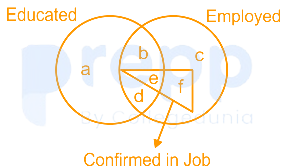
Read the given figure and find the region representing persons who are educated and employed but not confirmed in job.
The magazine in which Mahatma Gandhi mentioned what he wanted the Constitution to do is:
Which gas shields the surface of the earth from ultraviolet radiation from the sun?
Which event is marked as an Intangible Cultural Heritage of Humanity by UNESCO?
Who has been conferred with the rank of the Commander of the Order of the British Empire in 2018?


