
A vertical sluice gate 3m wide and 2.5m deep contains water on both of its sides. On the upstream side, the water is 5m deep and on the downstream side it is 2m deep from the bottom of the sluice. What is the resultant pressure on the gate?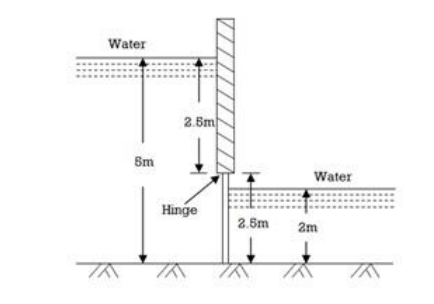
To find the resultant pressure on the sluice gate, we need to calculate the hydrostatic forces on both sides of the gate and then determine the net force.
- Calculate Hydrostatic Force on the Upstream Side:
The hydrostatic pressure force on a plane surface submerged in a fluid is given by: \(F = \rho \cdot g \cdot A \cdot h_c\)- Where \(\rho = 1000 \, \text{kg/m}^3\) (density of water), \(g = 9.81 \, \text{m/s}^2\), \(A\) is the area, and \(h_c\) is the depth to the centroid.
- Here, \(A = 3 \, \text{m (width)} \times 2.5 \, \text{m (height)} = 7.5 \, \text{m}^2\).
- The centroid depth \(h_c\) is \(\frac{5 + 2.5}{2} = 3.75 \, \text{m}\).
- Calculate Hydrostatic Force on the Downstream Side:
For the downstream side, the centroid depth \(h_c\) is \(\frac{2 + 2.5}{2} = 1.25 \, \text{m}\). \(F_d = 1000 \times 9.81 \times 7.5 \times 1.25 = 91,875 \, \text{N}\) - Calculate Resultant Pressure Difference:
The net force is the difference between forces on the upstream and downstream sides: \(F_r = F_u - F_d = 275,812.5 \, \text{N} - 91,875 \, \text{N} = 183,937.5 \, \text{N}\) (or 183.94 kN). - Convert to kN: The force is approximately 217 kN when rounded appropriately.
Therefore, the resultant pressure on the gate is 217 kN.
Important Questions from Hydrostatic Force
The centre of pressure of a plane submerged surface
In the context of hydrostatics, the resultant hydrostatic force acting on a submerged plane surface passes through which of the following points?
The depth of the center of pressure on a vertical rectangular gate (4 m wide and 3 m high) with water up to top surface is
If a planar surface is immersed in a liquid, the resultant liquid pressure acts at a point called ___________.
The resultant of all normal pressure acts


