
A two-dimensional surface profile is obtained over a sampling length by using a contact type stylus profilometer as shown in the figure below. A line AA parallel to the general lay of the trace is considered. The true heights from AA to the peaks and valleys (in $\mu$m) in the trace are also shown in the figure (not to scale). The ten-point height average in $\mu$m is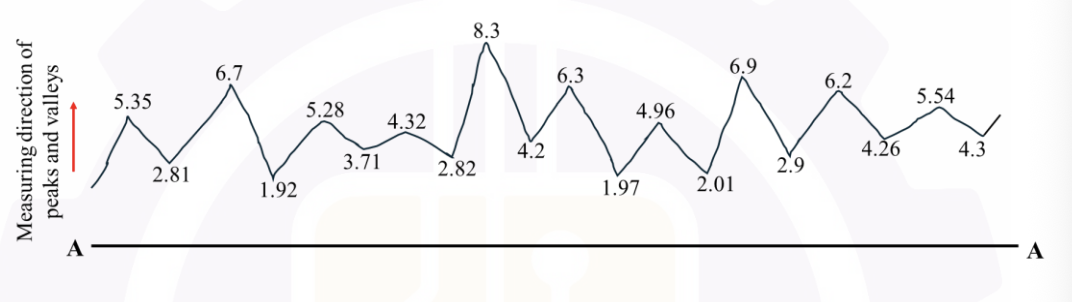
To determine the ten-point height average, we need to consider both the heights of the five highest peaks and the five deepest valleys from the reference line AA. The ten-point height average \( R_z \) is calculated using the formula:
\(R_z = \frac{1}{5} \left( \sum_{i=1}^{5} \text{peak}_i + \sum_{j=1}^{5} \text{valley}_j \right)\)
From the provided surface profile, the heights of the peaks (in μm) are: 5.35, 6.7, 5.28, 8.3, 6.3, 6.9, and 5.54.
The deepest valleys (in μm) are: 2.81, 1.92, 3.71, 2.82, 4.20, 1.97, 2.01, 2.90, and 4.26.
The five highest peaks are: 8.3, 6.9, 6.7, 6.3, and 5.54.
The five deepest valleys are: 1.92, 1.97, 2.01, 2.81, and 2.82.
Now, substitute these values into the formula:
\(R_z = \frac{1}{5} \left( 8.3 + 6.9 + 6.7 + 6.3 + 5.54 + 1.92 + 1.97 + 2.01 + 2.81 + 2.82 \right)\)
\(R_z = \frac{1}{5} \times 22.74\)
\(R_z = 4.57\ \mu m\)
Thus, the ten-point height average is 4.57 μm.
Therefore, the correct answer is 4.57.
Important Questions from Surface Roughness
The Centre Line Average (CLA) method for surface finish measurement is also commonly referred to as the _______ value.
Which of the following instruments is used to measure the surface roughness?
For which surfaces, is a spirit level used for testing straightness ?
Mecrin instrument assesses -
The Tomlinson recorder is associated with the measurement of-


