
A three-hinge arch ABC in the form of a semi-circle is shown in the figure. The arch is in static equilibrium under vertical loads of $ P = 100 \text{ kN} $ and $ Q = 50 \text{ kN} $. Neglect friction at all the hinges. The magnitude of the horizontal reaction at B is ________ $ \text{ kN} $ (rounded off to 1 decimal place).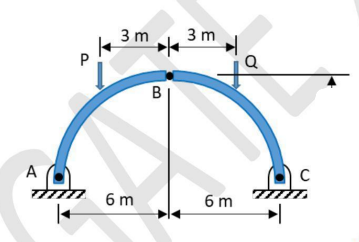
To find the magnitude of the horizontal reaction at hinge B, follow these steps:
1. Determine the vertical reactions at the supports A and C:
Let $V_A$ and $V_C$ be the vertical reactions at A and C respectively. The span of the arch is $12\text{ m}$ ($6\text{ m} + 6\text{ m}$).
Summing moments about A for the entire arch ($\sum M_A = 0$):
$V_C \times 12 - P \times 3 - Q \times 9 = 0$
Given $P = 100\text{ kN}$ and $Q = 50\text{ kN}$:
$12 V_C = 100 \times 3 + 50 \times 9 = 300 + 450 = 750$
$V_C = \frac{750}{12} = 62.5\text{ kN}$
2. Use the condition of the internal hinge B:
In a three-hinged arch, the bending moment at the internal hinge B is zero. We can analyze the right segment BC of the arch.
Summing moments about hinge B for segment BC ($\sum M_B = 0$):
$V_C \times 6 - H \times 6 - Q \times 3 = 0$
Where $H$ is the horizontal thrust, which is equal to the magnitude of the horizontal reaction at the supports and is transmitted through hinge B.
$62.5 \times 6 - 6H - 50 \times 3 = 0$
$375 - 6H - 150 = 0$
$6H = 225$
$H = \frac{225}{6} = 37.5\text{ kN}$
3. Conclusion:
The magnitude of the horizontal reaction at the internal hinge B is equal to the horizontal thrust $H$ required to maintain equilibrium.
The magnitude of the horizontal reaction at B is 37.5 kN.
Important Questions from Equilibrium
What is the pH of a solution prepared by dissolving $0.0025$ moles of $HNO_3$ in $250\,mL$ of water?
Which species acts as acid like behaviour in the following reaction?
\(HPO_4^{2-}+NH_4^{1+}\rightarrow H_2PO_4^{1-}+NH_3\)
Aqueous solution of CH 3COONa is:
pH of a neutral solution is ___________.
For the reaction N 2(g) + 3H 2(g) \(\rightleftharpoons\) 2NH 3(g) ΔH = -ve :


