
A test consists of 20 questions. A correct answer fetches 4 marks and a wrong answer is penalised by deducting 1 mark. Unattempted questions fetch nothing. If a candidate with a few wrong answers secures 44 marks, how many questions were attempted?
16
Solving Test Question Problem
The problem describes a test with 20 questions and a specific scoring system. We are given the total score obtained by a candidate who had a few wrong answers and need to find the number of questions they attempted.
Let's define the variables:
- C = Number of correct answers
- W = Number of wrong answers
- U = Number of unattempted questions
The total number of questions is 20. So, the sum of correct, wrong, and unattempted questions must be 20:
\begin{equation*} C + W + U = 20 \end{equation*}
The scoring system is:
- Correct answer: +4 marks
- Wrong answer: -1 mark
- Unattempted question: 0 marks
The candidate secured a total score of 44 marks. The total score is calculated as:
\begin{equation*} (4 \times C) + (-1 \times W) + (0 \times U) = 44 \end{equation*}
This simplifies to:
\begin{equation*} 4C - W = 44 \end{equation*}
We are also told that the candidate had 'a few wrong answers', which means the number of wrong answers (W) must be greater than 0:
\begin{equation*} W > 0 \end{equation*}
From the score equation ($4C - W = 44$), we can express W in terms of C:
\begin{equation*} W = 4C - 44 \end{equation*}
Since $W > 0$, we must have:
\begin{equation*} 4C - 44 > 0 \end{equation*}
\begin{equation*} 4C > 44 \end{equation*}
\begin{equation*} C > 11 \end{equation*}
So, the number of correct answers must be an integer greater than 11.
The number of attempted questions is the sum of correct and wrong answers: $C + W$. Since the total questions are 20, the number of attempted questions cannot exceed 20.
Let's test integer values for C starting from 12 (since $C > 11$):
Case 1: If $C = 12$
Using the equation $W = 4C - 44$, we find W:
\begin{equation*} W = 4(12) - 44 = 48 - 44 = 4 \end{equation*}
In this case, $W=4$, which is an integer and $W > 0$. This is a valid number of wrong answers.
The number of attempted questions would be $C + W = 12 + 4 = 16$.
The number of unattempted questions would be $U = 20 - (C + W) = 20 - 16 = 4$.
Let's verify the total questions and total score with these values:
- Total Questions: $C + W + U = 12 + 4 + 4 = 20$ (Correct)
- Total Score: $4C - W = 4(12) - 4 = 48 - 4 = 44$ (Correct)
This solution fits all the conditions of the problem.
Case 2: If $C = 13$
Using the equation $W = 4C - 44$, we find W:
\begin{equation*} W = 4(13) - 44 = 52 - 44 = 8 \end{equation*}
In this case, $W=8$, which is an integer and $W > 0$. This is valid so far.
The number of attempted questions would be $C + W = 13 + 8 = 21$.
However, the total number of questions in the test is only 20. It is impossible to attempt 21 questions out of 20.
Therefore, $C=13$ is not a valid solution.
Any value of C greater than 13 will result in a number of attempted questions ($C+W$) that is even larger than 21, and thus also impossible given the total of 20 questions.
The only valid case is when $C=12$, which leads to $W=4$.
The number of attempted questions is $C + W = 12 + 4 = 16$.
Thus, the candidate attempted 16 questions.
Important Questions from Miscellaneous
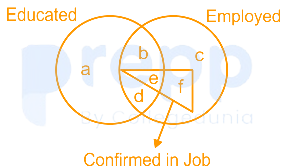
Read the given figure and find the region representing persons who are educated and employed but not confirmed in job.
The magazine in which Mahatma Gandhi mentioned what he wanted the Constitution to do is:
Which gas shields the surface of the earth from ultraviolet radiation from the sun?
Which event is marked as an Intangible Cultural Heritage of Humanity by UNESCO?
Who has been conferred with the rank of the Commander of the Order of the British Empire in 2018?


