A survey of 450 students about their subjects of interest resulted in the following outcome.
Based on the above information, the number of students interested in Humanities is
45
This problem involves analyzing a survey of 450 students to determine the number of students interested in Humanities. We are given the number of students interested in various combinations of Mathematics, Physics, and Chemistry. To solve this, we will use the Principle of Inclusion-Exclusion to find the total number of students interested in at least one of these three subjects and then subtract that from the total number of students surveyed.
Subject Interest Survey Data
Let's first list down the given information from the student survey about their subject interest:
- Total number of students surveyed = 450
- Students interested in Mathematics (M) = 150
- Students interested in Physics (P) = 200
- Students interested in Chemistry (C) = 175
- Students interested in Mathematics and Physics (M $\cap$ P) = 50
- Students interested in Physics and Chemistry (P $\cap$ C) = 60
- Students interested in Mathematics and Chemistry (M $\cap$ C) = 40
- Students interested in Mathematics, Physics, and Chemistry (M $\cap$ P $\cap$ C) = 30
- The remaining students are interested in Humanities.
| Subject/Combination | Number of Students |
|---|---|
| Mathematics (M) | 150 |
| Physics (P) | 200 |
| Chemistry (C) | 175 |
| Mathematics and Physics (M $\cap$ P) | 50 |
| Physics and Chemistry (P $\cap$ C) | 60 |
| Mathematics and Chemistry (M $\cap$ C) | 40 |
| Mathematics, Physics, and Chemistry (M $\cap$ P $\cap$ C) | 30 |
Applying the Inclusion-Exclusion Principle
To find the total number of students interested in at least one of the three core subjects (Mathematics, Physics, or Chemistry), we use the Principle of Inclusion-Exclusion for three sets. This principle helps us to count elements in the union of multiple sets by accounting for overlaps.
The formula for three sets M, P, and C is:
$$|M \cup P \cup C| = |M| + |P| + |C| - (|M \cap P| + |P \cap C| + |M \cap C|) + |M \cap P \cap C|$$
Where:
- $|M|$ represents the number of students interested in Mathematics.
- $|P|$ represents the number of students interested in Physics.
- $|C|$ represents the number of students interested in Chemistry.
- $|M \cap P|$ represents the number of students interested in both Mathematics and Physics.
- $|P \cap C|$ represents the number of students interested in both Physics and Chemistry.
- $|M \cap C|$ represents the number of students interested in both Mathematics and Chemistry.
- $|M \cap P \cap C|$ represents the number of students interested in Mathematics, Physics, and Chemistry.
Calculating Total Subject Interest
Now, let's substitute the given numerical values from the student survey into the Inclusion-Exclusion Principle formula to find the total number of students interested in at least one of the subjects (Mathematics, Physics, or Chemistry):
$$|M \cup P \cup C| = 150 + 200 + 175 - (50 + 60 + 40) + 30$$
First, we sum the number of students interested in each individual subject:
$$150 + 200 + 175 = 525$$
Next, we sum the number of students interested in the pairs of subjects:
$$50 + 60 + 40 = 150$$
Now, we substitute these sums back into the formula:
$$|M \cup P \cup C| = 525 - 150 + 30$$
Perform the subtraction:
$$525 - 150 = 375$$
Finally, add the number of students interested in all three subjects:
$$375 + 30 = 405$$
So, the total number of students interested in Mathematics, Physics, or Chemistry (or a combination of these) is 405.
Humanities Students Calculation
The problem states that the remaining students from the total survey population are interested in Humanities. To find the number of students interested in Humanities, we subtract the total number of students interested in Mathematics, Physics, or Chemistry from the total number of students surveyed.
- Total number of students surveyed = 450
- Number of students interested in Mathematics, Physics, or Chemistry = 405
Number of students interested in Humanities = Total number of students - Number of students interested in (Mathematics $\cup$ Physics $\cup$ Chemistry)
Number of students interested in Humanities = $$450 - 405$$
Number of students interested in Humanities = $$45$$
Therefore, based on the survey information, the number of students interested in Humanities is 45.
Important Questions from Logical Venn Diagram
Select the Venn diagram that best illustrates the relationship among the following classes.
Neptune, Planet, Moon
Teacher, College, Student –
Cabinet, Home Minister, Minister –
Professor, Researcher, Scientist –
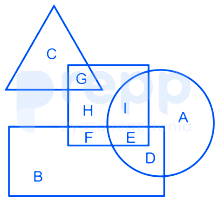
In the following figure, square represents Teachers, triangle represents swimmers, circle represents Nurses and rectangle represents Women. Which set of letters represent Teachers who are either swimmers or nurses?