
A square metal sheet of $4 \ m \times 4 \ m$ is placed on the x-y plane as shown in the figure below. If the surface charge density (in $\mu C/m^2$) on the sheet is $\rho_s(x, y) = 4|y|$, then the total charge (in $\mu C$, rounded off to the nearest integer) on the sheet is __________.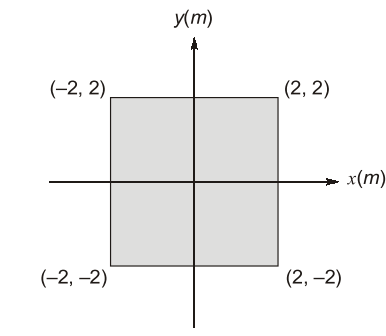
To find the total charge on the square metal sheet with given surface charge density, we need to integrate the surface charge density over the entire area of the sheet.
The metal sheet is positioned on the x-y plane with vertices at \((-2, -2)\), \((2, -2)\), \((-2, 2)\), and \((2, 2)\). The surface charge density is given by:
\rho_s(x, y) = 4|y| \, \mu C/m^2
Let's calculate the total charge Q on the sheet using the formula:
Q = \int \int \rho_s(x, y) \, dx \, dy
For this problem, we integrate over the area of the square from \(-2\) to \(2\) for both x and y:
Q = \int_{-2}^{2} \int_{-2}^{2} 4|y| \, dx \, dy
First, integrate with respect to \(x\):
\int_{-2}^{2} 4|y| \, dx = 4|y| \times (2 - (-2)) = 16|y|
Next, integrate with respect to \(y\):
Q = \int_{-2}^{2} 16|y| \, dy
Since \(|y|\) depends on the value of \(y\), we need to split it:
- For \(y\) from \(-2\) to \(0\), \(|y| = -y\)
- For \(y\) from \(0\) to \(2\), \(|y| = y\)
Thus, the integral becomes:
Q = \int_{-2}^{0} 16(-y) \, dy + \int_{0}^{2} 16y \, dy
Calculate each integral separately:
- \int_{-2}^{0} 16(-y) \, dy = 16 \left[ \frac{-y^2}{2} \right]_{-2}^{0} = 16 \left( 0 - \frac{-4}{2} \right) = 32
- \int_{0}^{2} 16y \, dy = 16 \left[ \frac{y^2}{2} \right]_{0}^{2} = 16 \left( \frac{4}{2} - 0 \right) = 32
Adding both integrals gives the total charge:
Q = 32 + 32 = 64 \, \mu C
Thus, the total charge on the sheet is \(64\) \(\mu C\), rounded off to the nearest integer.
The correct answer is 64.
Important Questions from Electrostatics
A uniform ring charge of radius $R$ carries a total charge $Q$. Which one of the following options correctly quantifies the magnitude of the force on a point charge of strength $q$ kept at the center of the ring?
($\epsilon$ is the permittivity of the medium)
For a uniform line charge of 8 nc/m lying along the z axis, the electric field at a radius of 3 m from the uniform line is given by :
The current in a coil of inductance 5 H changes linearly from 10 A to 2 A in t seconds. If the induced emf is 40 V, what is the time t?
What are the materials which exhibit electric polarization even in the absence of an applied electrical field?
What is the relative permittivity of slate dielectric?


