
A simply supported beam of length 1 m is subjected to a uniformly distributed bending moment of 1 N m per m throughout the length as shown in the figure given below. The bending moment at the mid-point of the beam is ______ N m (rounded off to the nearest integer).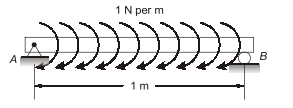
To find the bending moment at the mid-point of the beam, we will analyze the equilibrium of the beam and then apply the method of sections.
1. Identify Parameters and Support Reactions
The beam is simply supported at its ends $A$ and $B$ over a total length $L = 1 \text{ m}$. It is subjected to a uniformly distributed bending moment $m = 1 \text{ N m/m}$ acting in the clockwise direction throughout its length.
The total external moment applied to the beam is:
$M_{\text{ext}} = \int_{0}^{L} m \, dx = 1 \text{ N m/m} \times 1 \text{ m} = 1 \text{ N m}$ (clockwise)
Let $R_A$ and $R_B$ be the vertical reactions at the supports. For equilibrium, the reactions must provide a counter-clockwise couple to balance the applied moment. Taking moments about point $A$:
$\sum M_A = 0 \implies (R_B \times 1 \text{ m}) - 1 \text{ N m} = 0 \implies R_B = 1 \text{ N}$ (acting upwards)
From vertical equilibrium ($\sum F_y = 0$):
$R_A + R_B = 0 \implies R_A = -1 \text{ N}$ (acting downwards)
2. Calculate the Bending Moment at the Mid-point
Now, we consider a section at the mid-point $x = 0.5 \text{ m}$ from the left support $A$. We analyze the left portion of the beam to find the internal bending moment $M$.
Using the standard sign convention (sagging is positive):
- A downward force $R_A = 1 \text{ N}$ at the left end creates a negative bending moment: $M_R = -R_A \times x = -1 \text{ N} \times 0.5 \text{ m} = -0.5 \text{ N m}$.
- A clockwise distributed moment $m = 1 \text{ N m/m}$ to the left of the section creates a positive bending moment: $M_m = \int_{0}^{0.5} m \, dx = 1 \text{ N m/m} \times 0.5 \text{ m} = +0.5 \text{ N m}$.
The total internal bending moment at the mid-point is the sum of these contributions:
$M(0.5) = M_R + M_m = -0.5 \text{ N m} + 0.5 \text{ N m} = 0 \text{ N m}$
In fact, for this specific loading condition on a simply supported beam, the internal bending moment is zero at every point along the length of the beam because the reaction couple exactly balances the distributed moment at any given section.
Final Answer:
The bending moment at the mid-point of the beam is 0 N m.
Important Questions from Shear Force and Bending Moment
The shear force diagram for a simply supported beam carrying a uniformly distributed load of w per unit length, consists of:
The bending moment diagram of a simply supported beam carrying uniformly distributed load over the entire span is-
A simply supported beam is subjected to a linearly varying load from one end to other end. The nature of variation of shear force diagram is-
Which type of beam, freely supported at two points, has one or both ends extending beyond these supports?
Which of the following statements are correct?


