
A shopkeeper keeps the marked price of an article 40% above the cost price. If he increases discount from 6.5% to 15.5%, then the profit would decrease by Rs. 378. How much profit would he earn if he gives a discount of 27% on the marked price?
This problem involves understanding the relationship between Cost Price (CP), Marked Price (MP), Selling Price (SP), Discount, and Profit. We are given information about how a change in discount affects the profit, and we need to find the profit under a new discount scenario. Let's break down the problem step-by-step to calculate the original cost price, then the marked price, and finally the profit with the new discount.
Understanding Price Relationships
First, let's establish the relationship between the cost price and the marked price. The question states that the shopkeeper keeps the marked price of an article 40% above the cost price.
- Let the Cost Price (CP) of the article be \(\text{Rs. } C\).
- The Marked Price (MP) is 40% above the Cost Price.
\(\text{MP} = \text{CP} + 40\% \text{ of CP}\)
\(\text{MP} = C + 0.40C\)
\(\text{MP} = 1.4C\)
Calculating the Impact of Discount Changes
The problem provides information about two different discount scenarios and how the profit changes between them. This information is crucial for finding the actual values of CP and MP.
Scenario 1: Discount of 6.5%
When a discount of 6.5% is given on the marked price, the Selling Price (SP1) is calculated as follows:
- \(\text{SP}_1 = \text{MP} - 6.5\% \text{ of MP}\)
- \(\text{SP}_1 = \text{MP}(1 - 0.065)\)
- \(\text{SP}_1 = 0.935 \times \text{MP}\)
- Substitute \(\text{MP} = 1.4C\):
\(\text{SP}_1 = 0.935 \times (1.4C)\) - The Profit (Profit1) in this scenario is:
\(\text{Profit}_1 = \text{SP}_1 - \text{CP}\)
\(\text{Profit}_1 = (0.935 \times 1.4C) - C\)
Scenario 2: Discount of 15.5%
When the discount is increased to 15.5% on the marked price, the new Selling Price (SP2) is:
- \(\text{SP}_2 = \text{MP} - 15.5\% \text{ of MP}\)
- \(\text{SP}_2 = \text{MP}(1 - 0.155)\)
- \(\text{SP}_2 = 0.845 \times \text{MP}\)
- Substitute \(\text{MP} = 1.4C\):
\(\text{SP}_2 = 0.845 \times (1.4C)\) - The Profit (Profit2) in this scenario is:
\(\text{Profit}_2 = \text{SP}_2 - \text{CP}\)
\(\text{Profit}_2 = (0.845 \times 1.4C) - C\)
Determining the Cost Price (CP)
The problem states that if the discount increases from 6.5% to 15.5%, the profit would decrease by \(\text{Rs. } 378\). This means the difference between the first profit and the second profit is \(\text{Rs. } 378\).
- \(\text{Profit}_1 - \text{Profit}_2 = 378\)
- Substitute the expressions for \(\text{Profit}_1\) and \(\text{Profit}_2\) into the equation:
\(( (0.935 \times 1.4C) - C ) - ( (0.845 \times 1.4C) - C ) = 378\)
Simplify the equation by removing the parentheses and canceling out \(-C\) and \(+C\):
\(0.935 \times 1.4C - C - 0.845 \times 1.4C + C = 378\)
\(0.935 \times 1.4C - 0.845 \times 1.4C = 378\)
Factor out \(1.4C\):
\(1.4C \times (0.935 - 0.845) = 378\)
Perform the subtraction within the parentheses:
\(1.4C \times (0.09) = 378\)
Now, solve for \(C\):
\(1.4C = \frac{378}{0.09}\)
To simplify the division, multiply the numerator and denominator by 100:
\(1.4C = \frac{37800}{9}\)
\(1.4C = 4200\)
Finally, divide by 1.4 to find \(C\):
\(C = \frac{4200}{1.4}\)
\(C = \frac{42000}{14}\)
\(C = 3000\)
So, the Cost Price (CP) of the article is \(\text{Rs. } 3000\).
Calculating Marked Price (MP)
Now that we have the cost price, we can easily find the marked price using the initial relationship we established:
- \(\text{MP} = 1.4C\)
- Substitute the value of \(C\):
\(\text{MP} = 1.4 \times 3000\) - \(\text{MP} = 4200\)
The Marked Price (MP) of the article is \(\text{Rs. } 4200\).
Calculating Profit with 27% Discount
The final part of the question asks how much profit the shopkeeper would earn if he gives a discount of 27% on the marked price.
Step 1: Calculate Selling Price (SP3)
- The new discount is 27%.
- The Selling Price (SP3) is:
\(\text{SP}_3 = \text{MP} - 27\% \text{ of MP}\) - \(\text{SP}_3 = \text{MP}(1 - 0.27)\)
- \(\text{SP}_3 = 0.73 \times \text{MP}\)
- Substitute the calculated Marked Price \(\text{MP} = 4200\):
\(\text{SP}_3 = 0.73 \times 4200\)
\(\text{SP}_3 = 73 \times 42\)
| Calculation: 73 × 42 |
|---|
73 x 42 ---- 146 (73 x 2) 2920 (73 x 40) ---- 3066 |
- So, the Selling Price (SP3) with a 27% discount is \(\text{Rs. } 3066\).
Step 2: Calculate Profit (Profit3)
Profit is always the difference between the Selling Price and the Cost Price.
- \(\text{Profit}_3 = \text{SP}_3 - \text{CP}\)
- Substitute the values we found:
\(\text{Profit}_3 = 3066 - 3000\) - \(\text{Profit}_3 = 66\)
Therefore, the profit earned if a discount of 27% is given on the marked price would be \(\text{Rs. } 66\).
Summary of Key Values
| Parameter | Value |
|---|---|
| Cost Price (CP) | \(\text{Rs. } 3000\) |
| Marked Price (MP) | \(\text{Rs. } 4200\) |
| Selling Price (SP) with 27% Discount | \(\text{Rs. } 3066\) |
| Profit with 27% Discount | \(\text{Rs. } 66\) |
Important Questions from Miscellaneous
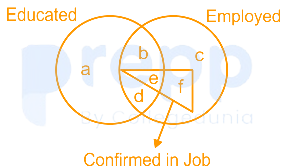
Read the given figure and find the region representing persons who are educated and employed but not confirmed in job.
The magazine in which Mahatma Gandhi mentioned what he wanted the Constitution to do is:
Which gas shields the surface of the earth from ultraviolet radiation from the sun?
Which event is marked as an Intangible Cultural Heritage of Humanity by UNESCO?
Who has been conferred with the rank of the Commander of the Order of the British Empire in 2018?


