
A satellite attitude control system, as shown below, has a plant with transfer function $G(s) = \frac{1}{s^2}$ cascaded with a compensator $C(s) = \frac{K(s+\alpha)}{s+4}$, where $K$ and $\alpha$ are positive real constants. 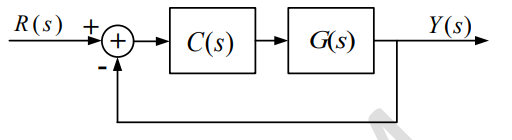
In order for the closed-loop system to have poles at $-1 \pm j\sqrt{3}$, the value of $a$ must be __________
To find the value of \( \alpha \) such that the closed-loop system has poles at \( s = -1 \pm j\sqrt{3} \), we use the Angle Criterion from the Root Locus method.
1. Identify Open-Loop Transfer Function
The open-loop transfer function \( L(s) \) is the product of the compensator \( C(s) \) and the plant \( G(s) \):
$$L(s) = C(s)G(s) = \frac{K(s + \alpha)}{s+4} \cdot \frac{1}{s^2} = \frac{K(s + \alpha)}{s^2(s + 4)}$$
From this, we identify the open-loop poles and zeros:
- Poles: \( p_1 = 0 \) (double pole at the origin), \( p_2 = -4 \)
- Zeros: \( z_1 = -\alpha \)
2. The Angle Criterion
For a point \( s_0 \) to be a closed-loop pole, it must satisfy the angle condition:
$$\sum \angle(s_0 + z_i) - \sum \angle(s_0 + p_i) = \pm 180^\circ (2n + 1)$$
Let the target pole be \( s_0 = -1 + j\sqrt{3} \).
3. Calculate Angles from Poles to \( s_0 \)
- Angle from poles at origin (\( s = 0 \)): Since there are two poles at the origin, the angle contribution is twice the angle of the vector from \( 0 \) to \( s_0 \). $$\theta_{p1} = \angle(-1 + j\sqrt{3}) = 180^\circ - \tan^{-1}\left(\frac{\sqrt{3}}{1}\right) = 180^\circ - 60^\circ = 120^\circ$$ Total contribution from origin poles = \( 2 \times 120^\circ = 240^\circ \).
- Angle from pole at \( s = -4 \): $$\theta_{p2} = \angle(s_0 - (-4)) = \angle(3 + j\sqrt{3}) = \tan^{-1}\left(\frac{\sqrt{3}}{3}\right) = \tan^{-1}\left(\frac{1}{\sqrt{3}}\right) = 30^\circ$$
4. Calculate Angle from Zero to \( s_0 \)
Let \( \phi_z \) be the angle contributed by the zero at \( s = -\alpha \). Applying the angle criterion:
$$\phi_z - (240^\circ + 30^\circ) = -180^\circ$$ $$\phi_z - 270^\circ = -180^\circ$$ $$\phi_z = 90^\circ$$
5. Solve for \( \alpha \)
The angle of the vector from the zero at \( -\alpha \) to the point \( s_0 = -1 + j\sqrt{3} \) is given by:
$$\angle(s_0 + \alpha) = \angle((\alpha - 1) + j\sqrt{3}) = 90^\circ$$
For a complex number to have an angle of \( 90^\circ \), its real part must be zero and its imaginary part must be positive:
$$\alpha - 1 = 0 \implies \alpha = 1$$
Final Answer
In order for the closed-loop system to have poles at \( -1 \pm j\sqrt{3} \), the value of \( \alpha \) must be 1.
Important Questions from Controllers and Compensators
Given below are two statements:
Statement I: In proportional control, the actuating signal for the control action in a control system is proportional to the error signal
Statement II: It is desirable that control system be over damped for the point of view of quick response
In the light of the above statements, choose thecorrectanswer from the options given below:
Which of the following controllers improves the transient response of a system?
The transfer function of the lead compensator is:
Which of the following terms is responsible for noise measurement in the PID controller?
The overall transfer function of a control system is given by the following equation. Find out the value of Derivative rate feedback constant K t. (Consider the Damping ratio 0.9)
\(\dfrac{C(s)}{R(s)}= \dfrac{36}{s^2+3.6s+36}\)


