
A rigid massless tetrahedron is placed such that vertex O is at the origin and the other three vertices A, B, and C lie on the coordinate axes as shown in the figure. The body is acted on by three point loads, of which one is acting at A along x-axis and another at point B along y-axis. For the body to be in equilibrium, the third point load acting at point O must be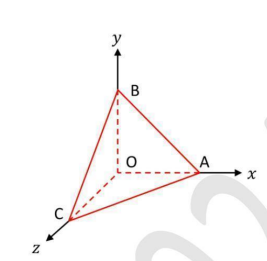
To solve this problem, we need to ensure the equilibrium of the tetrahedron under the action of the three forces. According to the conditions of equilibrium, the vector sum of all forces acting on the body must be zero.
Given:
- The first force \(F_1\) acts at point A along the x-axis, which is represented as \(\mathbf{F}_1 = F_1 \hat{i}\).
- The second force \(F_2\) acts at point B along the y-axis, represented as \(\mathbf{F}_2 = F_2 \hat{j}\).
We need to determine the third force \(F_3\) acting at point O to maintain equilibrium:
Since the body is in equilibrium, the sum of forces is zero:
\(\mathbf{F}_1 + \mathbf{F}_2 + \mathbf{F}_3 = \mathbf{0}\)
This implies:
\(F_1 \hat{i} + F_2 \hat{j} + \mathbf{F}_3 = \mathbf{0}\)
For equilibrium, the vector \(\mathbf{F}_3\) must balance both \(F_1 \hat{i}\) and \(F_2 \hat{j}\) along the x and y directions. Therefore, \(\mathbf{F}_3\) must effectively lie in the x-y plane, specifically at an angle such that neither its x-component nor its y-component is zero.
This implies that the third force must be:
- in the x-y plane but not along x or y axis
Hence, the correct option is: in x - y plane but not along x or y axis.
Important Questions from Equilibrium
What is the pH of a solution prepared by dissolving $0.0025$ moles of $HNO_3$ in $250\,mL$ of water?
Which species acts as acid like behaviour in the following reaction?
\(HPO_4^{2-}+NH_4^{1+}\rightarrow H_2PO_4^{1-}+NH_3\)
Aqueous solution of CH 3COONa is:
pH of a neutral solution is ___________.
For the reaction N 2(g) + 3H 2(g) \(\rightleftharpoons\) 2NH 3(g) ΔH = -ve :


