
A rigid circular disc of radius $r$ (in m) is rolling without slipping on a flat surface as shown in the figure below. The angular velocity of the disc is $\omega$ (in rad s$^{-1}$). The velocities (in m s$^{-1}$) at points O and A, respectively, are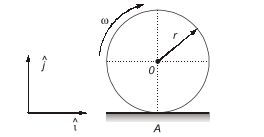
To solve the problem, we need to determine the velocities of points O and A on a rigid circular disc rolling without slipping on a flat surface.
Given:
- The radius of the disc is r (in meters).
- The angular velocity of the disc is \omega (in rad/s).
Concept: For a disc rolling without slipping on a flat surface, the point of contact (point A) with the ground has zero velocity, as it momentarily comes to rest before rolling over.
Velocities at Points O and A:
-
Velocity at Point O:
The center of the disc (point O) moves with a velocity due to the rotation of the disc. The linear velocity v_O of point O is given by:
v_O = r\omega
The direction of this velocity is along the horizontal axis (positive \hat{i} direction), hence:
v_O = r\omega \hat{i}
-
Velocity at Point A:
Point A is the point of contact with the ground during rolling without slipping. At any instant, the velocity of this point is zero because it is instantaneously at rest:
v_A = 0
Therefore, the velocities at points O and A are r\omega\hat{i} and 0, respectively.
Conclusion: The correct answer is r\omega\hat{i} and 0.
Important Questions from Kinematics and Kinetics
Consider the motion of a point on a circular trajectory. The acceleration in a linear motion (a) and the acceleration in angular motion (α), are related as : (Take r as the radius of circular trajectory)
A body of mass 10 kg moving with a velocity of 1 m/s is acted upon by a force of 50 N for two seconds. The final velocity will be:
A ball is dropped on a smooth horizontal surface from height ‘h’. What will be the height of rebounce after second impact, if coefficient of restitution between ball and surface is ‘e’?
Each of four particles move along an x-axis. Their coordinates (in meters) as functions of time (in seconds) are given by
1) particle 1: x (t) = 3.5 – 2.7 t3
2) particle 2: x (t) = 3.5 + 2.7 t3
3) particle 3: x (t) = 3.5 – 2.7 t2
4) particle 4: x (t) = 3.5 – 3.4t - 2.7 t2
Which of these particles have constant acceleration?
If water in a stream is flowing with a velocity of 20 kmph and a boat is travelling from one bank to another bank, if the velocity of boat in a direction perpendicular to direction of stream is 20 kmph and width of the stream is 2km, then the time taken and the angle at which boat makes with the direction stream is,


