
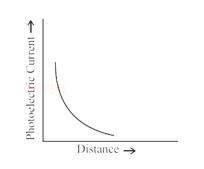
A point source causing photoelectric emission from a metallic plate is moved away from the plate. The variation of photoelectric current with distance from the source is correctly represented by the graph:
Understanding Photoelectric Emission and Light Intensity
Photoelectric emission is a phenomenon where electrons are ejected from a metal surface when light of sufficient frequency falls on it. The ejected electrons are called photoelectrons, and the flow of these electrons constitutes the photoelectric current.
The magnitude of the photoelectric current depends on several factors, including the intensity of the incident light, the frequency of the incident light, the material of the metallic plate, and the potential difference between the plate and the collector electrode (if any). In this question, we are considering how the photoelectric current varies with the distance of a point source of light from the metallic plate, assuming other factors remain constant.
Light Intensity from a Point Source
For a point source emitting light uniformly in all directions, the intensity of light at a given distance from the source follows the inverse square law. This means that the intensity of light ($I$) is inversely proportional to the square of the distance ($r$) from the source.
Mathematically, this relationship can be expressed as:
$$I \propto \frac{1}{r^2}$$
This implies that as the distance $r$ increases, the intensity $I$ decreases rapidly.
Photoelectric Current and Light Intensity
According to the theory of the photoelectric effect, the number of photoelectrons emitted per unit time is directly proportional to the intensity of the incident light, provided the frequency of the light is above the threshold frequency of the metal.
Since the photoelectric current ($J$) is proportional to the number of photoelectrons emitted per unit time, it follows that the photoelectric current is directly proportional to the intensity of the incident light:
$$J \propto I$$
Relating Photoelectric Current and Distance
Combining the relationship between light intensity and distance from a point source ($I \propto \frac{1}{r^2}$) with the relationship between photoelectric current and light intensity ($J \propto I$), we can find how the photoelectric current varies with the distance from the point source:
$$J \propto I \propto \frac{1}{r^2}$$
Therefore, the photoelectric current ($J$) is inversely proportional to the square of the distance ($r$) from the point source:
$$J \propto \frac{1}{r^2}$$
Analyzing the Graphs
We are looking for a graph that shows the photoelectric current decreasing with increasing distance according to the inverse square law ($J \propto 1/r^2$).
- Graph 1 shows a linear decrease in current with distance. This is incorrect, as the relationship is inverse square, not linear.
- Graph 2 shows a curve, but its specific form isn't clearly $1/r^2$.
- Graph 3 shows a curve that starts high at small distances and drops off rapidly as distance increases, approaching zero asymptotically. This shape is characteristic of an inverse square relationship like $y \propto 1/x^2$.
- Graph 4 shows the current initially increasing and then decreasing, which is incorrect.
Based on our analysis, Graph 3 correctly represents the variation of photoelectric current with the distance from a point source, following the inverse square law for light intensity.
Revision Table: Key Concepts
| Concept | Description | Relationship |
|---|---|---|
| Photoelectric Effect | Emission of electrons from a metal when light strikes it. | Triggered by light of sufficient frequency. |
| Photoelectric Current | Flow of photoelectrons. | Proportional to the number of emitted electrons. |
| Light Intensity (Point Source) | Power of light per unit area. | $I \propto \frac{1}{r^2}$ (Inverse Square Law) |
| Photoelectric Current vs. Intensity | How current changes with light brightness. | $J \propto I$ |
| Photoelectric Current vs. Distance (Point Source) | How current changes as source moves away. | $J \propto \frac{1}{r^2}$ |
Additional Information: Factors Affecting Photoelectric Current
Besides the distance from a point source, several other factors influence the photoelectric current:
- Light Frequency: Photoelectric emission only occurs if the incident light frequency is greater than or equal to the threshold frequency ($\nu_0$) of the metal. Increasing the frequency beyond the threshold increases the kinetic energy of the emitted photoelectrons, but it does not directly increase the number of emitted electrons (and thus the current), assuming intensity is constant.
- Light Intensity: The number of photoelectrons emitted per unit time is directly proportional to the intensity of the incident light (provided $\nu \ge \nu_0$). Higher intensity means more photons striking the surface, leading to more emissions.
- Material of the Metal Plate: Different metals have different threshold frequencies and work functions (the minimum energy required to eject an electron).
- Applied Potential Difference: If there is a potential difference between the metallic plate and a collector electrode, it can affect the measured current. A positive potential on the collector attracts more photoelectrons, increasing the current until saturation is reached (when all emitted electrons are collected). A negative potential opposes the flow, and at a sufficiently negative potential (stopping potential), the current becomes zero.
In the context of this question, when only the distance from a point source is varied, the intensity changes, directly impacting the photoelectric current according to the inverse square law.
Important Questions from Dual Nature of Radiation and Matter
The wavelength of light from the spectral emission line of sodium is 662 nm. The kinetic energy at which an electron would have the same de Broglie wavelength would be: (h=6.62×10⁻³⁴J⋅s,me=9×10⁻³¹kg)
Energy of a photon corresponding to a wavelength of 600 nm is 2.08 eV. The energy of a photon of wavelength 400 nm will be:
A particle moves three times as fast as an electron. The ratio of the de Broglie wavelength of the particle to that of the electron is 1.813 × 10⁻⁴. The mass of the particle is:
According to Einstein’s photoelectric equation, the plot of the Kinetic Energy of the emitted photoelectrons from a metal versus the frequency of the incident radiation gives a straight line whose slope:
Energy of a photon corresponding to a wavelength of 600 nm is 2.08 eV. The energy of a photon of wavelength 400 nm will be:


