
A plane, solid slab of thickness $L$, shown in the figure, has thermal conductivity $k$ that varies with the spatial coordinate $x$ as $k = A + Bx$, where $A$ and $B$ are positive constants ($A > 0, B > 0$). The slab walls are maintained at fixed temperatures of $T(x = 0) = 0$ and $T(x = L) = T_0 > 0$. The slab has no internal heat sources.>Considering one-dimensional heat transfer, which one of the following plots qualitatively depicts the steady-state temperature distribution within the slab?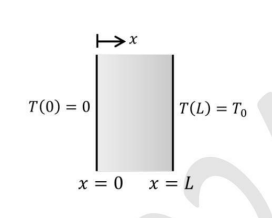
To determine the steady-state temperature distribution within the slab, let's consider the heat conduction equation. Since the thermal conductivity varies with position, the equation used is:
\(\frac{d}{dx}\left(k \frac{dT}{dx}\right) = 0\)
Given that \(k = A + Bx\), we substitute this into the equation:
\(\frac{d}{dx}\left((A + Bx) \frac{dT}{dx}\right) = 0\)
Integrating once with respect to \(x\) gives:
\((A + Bx) \frac{dT}{dx} = C_1\)
where \(C_1\) is a constant of integration. Solving for \(\frac{dT}{dx}\):
\(\frac{dT}{dx} = \frac{C_1}{A + Bx}\)
Integrating again to solve for \(T(x)\):
\(T(x) = \int \frac{C_1}{A + Bx} \, dx\)
This yields:
\(T(x) = \frac{C_1}{B} \ln(A + Bx) + C_2\)
where \(C_2\) is another integration constant. Applying the boundary conditions:
- At \(x = 0\), \(T = 0\).
- At \(x = L\), \(T = T_0\).
We solve for \(C_1\) and \(C_2\) using these boundary conditions:
1. Substituting \(T(0) = 0\):
\(0 = \frac{C_1}{B} \ln(A) + C_2\)
2. Substituting \(T(L) = T_0\):
\(T_0 = \frac{C_1}{B} \ln(A + BL) + C_2\)
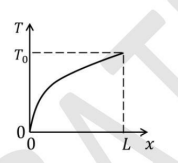
This implies a logarithmic temperature distribution, which is concave from \(T(0)\,=\,0\) to \(T(L)\,=\,T_0\).
Therefore, the correct plot is the one that shows a logarithmic increase in temperature starting from \(T = 0\) at \(x = 0\) and reaching \(T = T_0\) at \(x = L\).
Important Questions from Conduction
In M - L - t - T system, the dimension of thermal diffusivity is -
The transfer of heat through the molecules of matter in any body is called ________.
Unit of thermal diffusivity is
When heat is transferred from one particle of hot body to another by actual motion of the heated particles, it is referred to as heat transfer by:
Which of the following is a case of steady state heat transfer?


