
A particle is constrained to move in a truncated harmonic potential well ($x > 0$) as shown in the figure. Which one of the following statements is CORRECT?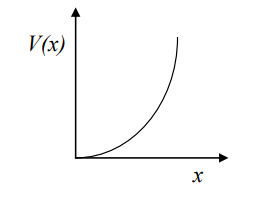
In this problem, we are dealing with a particle constrained to move in a truncated harmonic potential well, where \( x > 0 \). This means that the potential energy function \( V(x) \) is only defined for \( x > 0 \) and is harmonic in nature.
The standard quantum harmonic oscillator potential is given by:
\(V(x) = \frac{1}{2}m\omega^2x^2\)
The energy levels of a typical quantum harmonic oscillator are:
\(E_n = \left(n + \frac{1}{2}\right)\hbar\omega\) where \( n = 0, 1, 2, \ldots \)
Now, consider the conditions given in the problem:
- The potential is only defined for \( x > 0 \), implying that the parity symmetry present in a full harmonic potential is broken.
Let's evaluate the given options:
- The parity of the first excited state is even: In a truncated potential like this, parity is not well-defined because the wave functions do not extend over \( x < 0 \).
- The parity of the ground state is even: Similarly, the notion of parity is not applicable here due to the restriction to \( x > 0 \).
- The ground state energy is \(\frac{1}{2}\hbar\omega\): For a half harmonic oscillator starting from \( x > 0 \), the energies are shifted. The energy levels are typically higher than the standard oscillator.
- The first excited state energy is \(\frac{7}{2}\hbar\omega\): This is correct for a particle in a half-space harmonic oscillator potential, where energy levels are adjusted because the node structure and allowed states change. This matches the known result for the first excited state of a half-harmonic oscillator.
Thus, the correct answer is that the first excited state energy is \(\frac{7}{2}\hbar\omega\).
Important Questions from Schrödinger Equation 1D Potentials Harmonic Oscillator
- The energy $E$ and degeneracy $d$ of the second excited state of a three-dimensional, isotropic quantum harmonic oscillator with angular frequency $\omega$ are
- A particle of mass $ m $ is in a potential $ V(x) = \frac{1}{2}m\omega^2x^2 $ for $ x > 0 $ and $ V(x) = \infty $ for $ x \leq 0 $, where $ \omega $ is the angular frequency. The ratio of the energies corresponding to the lowest energy level to the next higher level is
- Young's double slit experiment is performed using a beam of $C_{60}$ (fullerene) molecules, each molecule being made up of 60 carbon atoms. When the slit separation is 50 nm, fringes are formed on a screen kept at a distance of 1 m from the slits. Now, the experiment is repeated with $C_{70}$ molecules with a slit separation of 92.5 nm. The kinetic energies of both the beams are the same. The position of the 4th bright fringe for $C_{60}$ will correspond to the $n^{th}$ bright fringe for $C_{70}$. What is the value of $n$ (rounded off to the nearest integer) ?
- Consider a particle in a two dimensional infinite square well potential of side $L$, with $0 \le x \le L$ and $0 \le y \le L$. The wavefunction of the particle is zero only along the line $y = \frac{L}{2}$, apart from the boundaries of the well. If the energy of the particle in this state is $E$, what is the energy of the ground state?
The wavefunction of a particle in an infinite one-dimensional potential well at time $t$ is
$\Psi(x, t) = \sqrt{\frac{2}{3}} e^{-iE_1t/\hbar}\psi_1(x) + \frac{1}{\sqrt{6}} e^{i\pi/6}e^{-iE_2t/\hbar}\psi_2(x) + \frac{1}{\sqrt{6}} e^{i\pi/4}e^{-iE_3t/\hbar}\psi_3(x)$
where $\psi_1, \psi_2$ and $\psi_3$ are the normalized ground state, the normalized first excited state and the normalized second excited state, respectively. $E_1, E_2$ and $E_3$ are the eigen-energies corresponding to $\psi_1, \psi_2$ and $\psi_3$, respectively. The expectation value of energy of the particle in state $\Psi(x, t)$ is


