
A loan is to be returned in two equal yearly installments. If the rate of interest is 15% per annum, compounded annually and each installment is Rs. 5,819, then the total interest charged (in Rs.) is:
Loan Repayment Analysis
This problem asks us to determine the total interest charged on a loan that is repaid in two equal yearly installments. We are given the installment amount, the interest rate, and that the interest is compounded annually. To find the total interest, we first need to calculate the original principal loan amount.
Understanding Loan Installments
When a loan is repaid through equal installments, each payment consists of a part of the principal loan amount and the interest accumulated over time. To find the initial principal, we calculate the present value of each future installment. The present value is simply what a future sum of money is worth today, considering a specific interest rate.
- Installment Amount: Each installment paid is Rs. 5,819.
- Number of Installments: The loan is to be returned in two equal yearly installments.
- Interest Rate: The annual interest rate is 15%, compounded annually.
Calculating Present Value of Each Installment
To find the present value (PV) of a future payment (\(F\)) that will be received after \(n\) years at an annual interest rate (\(r\)) compounded annually, we use the following formula:
\(PV = \frac{F}{(1+r)^n}\)
Let's apply this to our given values:
- Future Payment (\(F\)) = Rs. 5,819 (this is the value of each installment)
- Annual Rate of Interest (\(r\)) = 15% = 0.15
Present Value of the First Installment
The first installment is paid at the end of the first year. So, for this installment, \(n=1\).
\(PV_1 = \frac{\text{Installment Amount}}{(1+\text{Rate})^1}\)
\(PV_1 = \frac{5819}{(1+0.15)^1}\)
\(PV_1 = \frac{5819}{1.15}\)
\(PV_1 = 5060\)
Present Value of the Second Installment
The second installment is paid at the end of the second year. So, for this installment, \(n=2\).
\(PV_2 = \frac{\text{Installment Amount}}{(1+\text{Rate})^2}\)
\(PV_2 = \frac{5819}{(1+0.15)^2}\)
\(PV_2 = \frac{5819}{(1.15)^2}\)
\(PV_2 = \frac{5819}{1.3225}\)
\(PV_2 = 4400\)
Principal Loan Amount Calculation
The original principal loan amount is the sum of the present values of all installments. This represents the total value of the loan at the beginning, before any payments were made.
\(\text{Principal Loan Amount} = PV_1 + PV_2\)
\(\text{Principal Loan Amount} = 5060 + 4400\)
\(\text{Principal Loan Amount} = 9460 \text{ Rs.}\)
Total Amount Paid Calculation
The total amount paid by the borrower is the sum of all the installments paid over the repayment period.
\(\text{Total Amount Paid} = \text{Number of Installments} \times \text{Each Installment Amount}\)
\(\text{Total Amount Paid} = 2 \times 5819\)
\(\text{Total Amount Paid} = 11638 \text{ Rs.}\)
Interest Charged Calculation
The total interest charged on the loan is the difference between the total amount the borrower paid back and the initial principal loan amount.
\(\text{Total Interest Charged} = \text{Total Amount Paid} - \text{Principal Loan Amount}\)
\(\text{Total Interest Charged} = 11638 - 9460\)
\(\text{Total Interest Charged} = 2178 \text{ Rs.}\)
| Description | Amount (Rs.) |
|---|---|
| Present Value of 1st Installment | 5060 |
| Present Value of 2nd Installment | 4400 |
| Principal Loan Amount | 9460 |
| Total Amount Paid (2 x 5819) | 11638 |
| Total Interest Charged | 2178 |
The total interest charged for this loan is Rs. 2,178.
Important Questions from Miscellaneous
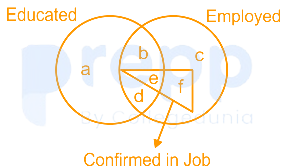
Read the given figure and find the region representing persons who are educated and employed but not confirmed in job.
The magazine in which Mahatma Gandhi mentioned what he wanted the Constitution to do is:
Which gas shields the surface of the earth from ultraviolet radiation from the sun?
Which event is marked as an Intangible Cultural Heritage of Humanity by UNESCO?
Who has been conferred with the rank of the Commander of the Order of the British Empire in 2018?


