A line of symmetry is defined as a line that divides a figure into two parts in a way such that each part is a mirror image of the other part about that line.
The given figure consists of 16 unit squares arranged as shown. In addition to the three black squares, what is the minimum number of squares that must be coloured black, such that both PQ and MN form lines of symmetry? (The figure is representative)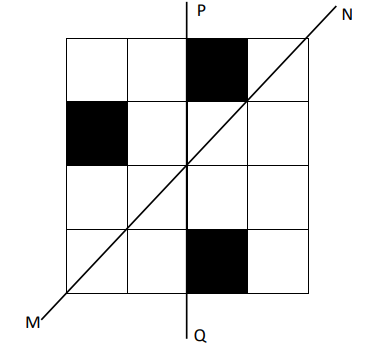
To solve this problem, we need to ensure that both lines PQ and MN form lines of symmetry for the given figure. Here’s a step-by-step approach:
Step 1: Identifying Symmetry along MN
The line MN is a diagonal line of symmetry. For this line, consider each square on one side of MN and ensure there is a corresponding black square on the opposite side:
- In the first row, the third square from the left is already black. Mirror it to the fourth row, first square.
- In the second row, the first square from the left is black. Mirror it to the third row, third square.
Step 2: Identifying Symmetry along PQ
The line PQ is a vertical line of symmetry. For this line, consider the arrangement of squares on one half and mirror it to the other half:
- The first row’s second square is black. Mirror it to the first row, fifth square.
- The third row’s fourth square is black. Mirror it to the third row, second square.
Step 3: Conclusion
Initially, there are 3 black squares. To achieve symmetry about both lines PQ and MN, we added:
- One extra square for MN symmetry.
- Two extra squares for PQ symmetry.
Therefore, a total of 5 squares (including the initial 3) need to be black for both lines to be lines of symmetry.
Thus, the minimum number of additional squares that must be colored black is 5.
Important Questions from Patterns in 2 and 3 Dimensions
The next figure (indicated by '?') in the sequence is