
A gear train with five gears is shown in the figure below. The number of teeth on each gear is $\text{N}_1$, $\text{N}_2$, $\text{N}_3$, $\text{N}_4$, and $\text{N}_5$. The idler gear in this gear train is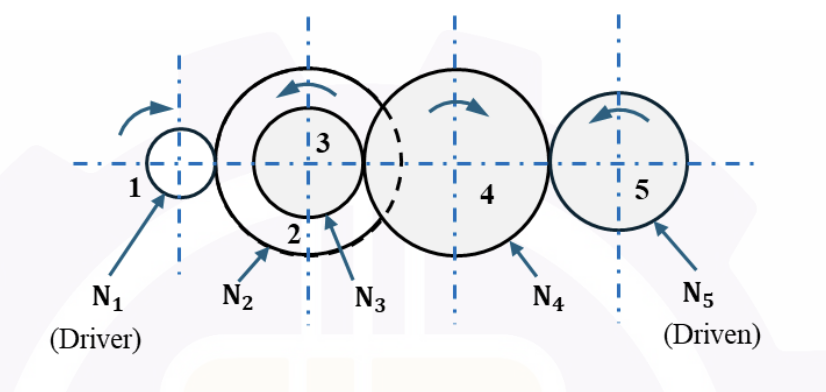
To determine which gear is an idler gear in the given gear train, we need to understand the role of an idler gear in a gear system. An idler gear is typically used to change the direction of rotation of the output gear while not affecting the gear ratio between the driver and the driven gears.
In the given figure:
- Gear 1 is the driver gear.
- Gear 5 is the driven gear.
- We need to determine which gear between these acts as an idler gear.
Let's analyze the gear system:
- Gear 1 drives Gear 2, changing only the direction of rotation of Gear 2.
- Gear 2 drives Gear 3.
- Gear 3 drives Gear 4.
- Gear 4 drives Gear 5, the final driven gear.
The purpose of the idler gear is to pass the motion without altering the speed ratio between the driver (Gear 1) and the driven gear (Gear 5). It serves primarily to change the direction of rotation or connect gears that are not directly in contact.
Among the options, Gear 4 is effectively positioned to fulfill this role, as it connects Gear 3 and Gear 5 while passing the rotational motion without changing the overall gear ratio between Gears 1 and 5.
Thus, the idler gear in this gear train is Gear 4.
Important Questions from Gear Trains
In a Gear Train of n wheels, the speed ratio is defined as
The Interference or undercutting in involute gears can be avoided by:
In gears, interference takes place when _____.
The radius that connects the root circle to the profile of the tooth is known as ________.
In an involute gear, the base circle must be ____.


